
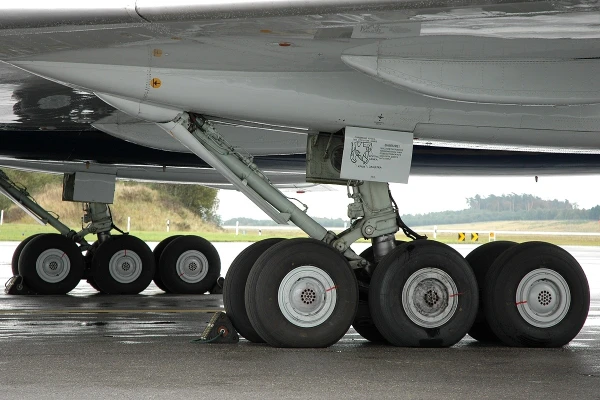
Last year, nearly two thousand tons of natural rubber were exported from European Union countries to Russia. As the Ukrainian Economic Security Council found out, one of the main supply routes for natural rubber from the EU to the Russian Federation, where this rubber is used, among other things, for the production of tires for military aircraft, leads precisely through Latvia.
Irreplaceable Raw Material
Natural rubber is one of the most valuable types of raw materials for the production of military products. "Rubber is a very durable rubber material that can also be used in civil aviation. And in various fastenings in tracked mechanisms," says Elina Egle, head of the Latvian Federation of Defense and Security Industries. Natural rubber is in high demand because its properties cannot be fully replicated by synthetic substitutes. This means that natural rubber is available in limited quantities.
Russia, which uses rubber, among other things, for the production of tires for military aircraft, depends on imports of this raw material. "Russia produces synthetic rubber; however, it does not have the properties of natural rubber that are necessary for the strength, durability, and efficiency of aviation tires," explains Elena Yurchenko, director of analysis, investigations, and research at the Ukrainian Economic Security Council.
Natural rubber in Russia is used, among other things, for the production of tires for planes that carry out missile and aerial bombing strikes on Ukraine. In particular, in 2023 and 2024, Russian aviation used about 70 armored aircraft Su-34 and Su-35S. However, as the Ukrainian Economic Security Council found out, the Russian Federation depends on natural rubber for the production of tires for these aircraft.
Latvia is an intermediary in this scheme, concluded the Ukrainian Economic Security Council, which examined customs declarations in the Export Genius database. Specifically, natural rubber is mainly produced in Malaysia and Indonesia. Given that these countries are not under sanctions, natural rubber from them is usually exported to the Russian Federation directly or through China. However, rubber also reaches Russia through European countries. As concluded in Ukraine, last year suppliers from the European Union exported natural rubber to Russia worth over two and a half million euros. "European countries are not producers themselves, but since export is not prohibited, they can be used as re-export centers," says Yurchenko.
According to a Ukrainian study, Latvia provided 86% of all natural rubber supplied to Russia from the European Union.
The remaining fourteen percent was supplied by Italy.
Two Latvian Companies Involved
The study by the Ukrainian Economic Security Council shows that last year two Latvian companies sent natural rubber worth over two million euros through Latvia to five enterprises linked to the Russian Federation. According to Lursoft data, one enterprise provides transport support services, while the other offers freight forwarding services.
De facto, it is known which Latvian firms are involved as exporters of natural rubber; however, both deny that they sent cargo to the mentioned enterprises last year. Both companies also claim that they strictly comply with the requirements of legislation and mandatory regulations. Now, after the publication Politico reported that natural rubber is being sent to Russia through Latvia, security agencies are investigating the situation.
Security Agencies Assess the Situation
"We immediately requested information from security services because this is natural rubber. This is an unsanctioned product, and it is used in various ways. The first thing we need to do is understand whether there has indeed been a violation of sanctions, whether the supply was directly to the military complex. We are currently waiting for a conclusion from our security agencies," says Artyom Urshulskis, parliamentary secretary of the Ministry of Foreign Affairs.
The Ministry of Foreign Affairs hopes to receive a conclusion from the security agencies within the next two weeks.
Latvia to Propose Sanctions on Rubber
Natural rubber, unlike synthetic rubber, is currently not subject to sanctions. Moreover, enterprises linked to Russia that officially receive natural rubber through Latvia are not included in the European Union's sanctions list. "I think this is a question of a loophole in the sanctions because it is impossible to cover absolutely all restrictions and all specific goods and services that are part of the exchange between Russia and European countries," believes Politico author Gerardo Fortuna.
De facto, it is known that Latvia, in discussions about the next, i.e., the twentieth, package of sanctions expected early next year, will call for sanctions on rubber.
However, it is already known that there will be countries that will oppose this proposal. "In every round of negotiations on sanctions, there is one important feature — if even just one country refuses to agree, it means that the sanctions automatically lose their power. In this sense, unanimity is both a strength of the system and its limitation," says Fortuna.
More clarity on what the next package of sanctions may look like is expected in March.
2023 – Peak Year for Rubber and Its Products Export to Russia
Overall, the export of rubber and its products from Latvia to Russia over the past five years has been very uneven. Until 2023, it was rapidly growing, but then it significantly fell. According to the Central Statistical Bureau (CSB) data, in 2023, the export of rubber and its products to Russia was estimated at 41.15 million euros; in 2024, this export decreased to 19.97 million euros.
However, these CSB data do not reflect rubber that has only "passed through" Latvia or, in other words, was re-exported.
Latvia still exports rubber and its products to Russia worth millions of euros, mainly tires.
The chairman of the Saeima subcommittee on export and competitiveness, Arturs Butans (National Alliance), believes that it is necessary to check more carefully whether the raw materials exported from Latvia are being used in the military industry. "When information about the export of manganese ore emerged, that it was going through Latvia and being used in the military industry, we already called on the Cabinet of Ministers to act. There were calls to ensure that this is the only raw material and that no other is being used in the military industry.
Currently, the signals received about rubber indicate that it is used both in aviation and for howitzers, and mainly for tires," says Butans.
He expects that this task should be taken on by the Ministry of Foreign Affairs.
Moreover, there is currently no publicly available information on which enterprises export goods from Latvia to Russia. The most relevant available data relates to the summer of last year. So far, the Ministry of Economics has not managed to find a solution on how to balance the public's right to know the exporters and the potential risks of legal disputes.










Leave a comment