
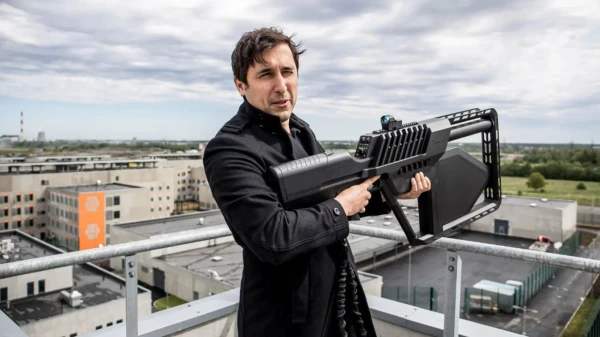
The company's revenue has already reached $200 million.
Oleg Vornik, a financier and mathematician by education, who left Russia as a teenager and grew up in social housing in New Zealand, manages a drone defense company, DroneShield, in Australia, writes The Australian Financial Review. The company is one of the world leaders in the sector and was valued at nearly $6 billion on the stock market at its peak. It is included in the S&P/ASX 200 index. Vornik initially became the company's financial director, and in 2017 he took on the role of CEO. He was never an engineer; the founders were two Americans — John Franklin and Brian Hiring. Both studied at the American MIT and worked with the defense sector.
Vornik admits that the sharp growth of the business began after Russia's invasion of Ukraine when the fight against drones became a national security issue for many countries. Supplies to Ukraine brought the company tens of millions of dollars. In 2022, Vornik was placed under Russian sanctions for assisting Ukraine, and the company sharply increased in value amid the growth of the defense sector. Particularly, the business growth was aided by a $33 million contract from the U.S. in July 2023. This attracted interest from major buyers. The company now supplies equipment to 50 countries. DroneShield sells sensors, jamming systems, and portable anti-drone devices. They are used to protect military facilities, infrastructure, and mass events. Recently, the company signed the largest contract in its history for $60 million with a European customer.
DroneShield's revenue in 2024 reached $193 million compared to $57 million the previous year. The company is expanding its production capacity and opening offices in Europe and the U.S. It has also promised to sharply increase sales again.
Against this backdrop, the company's stock rose nearly 800%. However, due to trading in the shares, the company's management found itself in scandal twice. On February 29, 2024, three board members — Vornik, Peter James, and Jethro Marks — sold large blocks of shares. At that time, Vornik earned $7.2 million, which raised concerns among investors. But that was not all — in early November of this year, DroneShield announced that it had achieved annual revenue of $200 million. This milestone activated a bonus program: Vornik, James, and Marks were allocated an additional 44.5 million shares. On the evening of November 13, 2025, three reports from directors about the sale of shares were submitted to the ASX exchange system. For example, Vornik sold shares worth $50 million, which he had received just a few days earlier. The next day, the shares plummeted by 30%, and by the end of the week, the decline reached 80% from the recent peak. Investors were shocked that management was selling shares again.
The decline in shares almost coincided with the start of discussions on Donald Trump's peace plan for Ukraine, which was accompanied by a general decline in defense sector stocks. For example, German shares of Rheinmetall fell by 16% over the month. Doubts about DroneShield's prospects arose for other reasons as well. The products are quite expensive, but they cannot jam Russian drones on fiber-optic cables, and the famous DroneShield 'guns' expose the operator and are difficult to use on the battlefield.









Leave a comment