
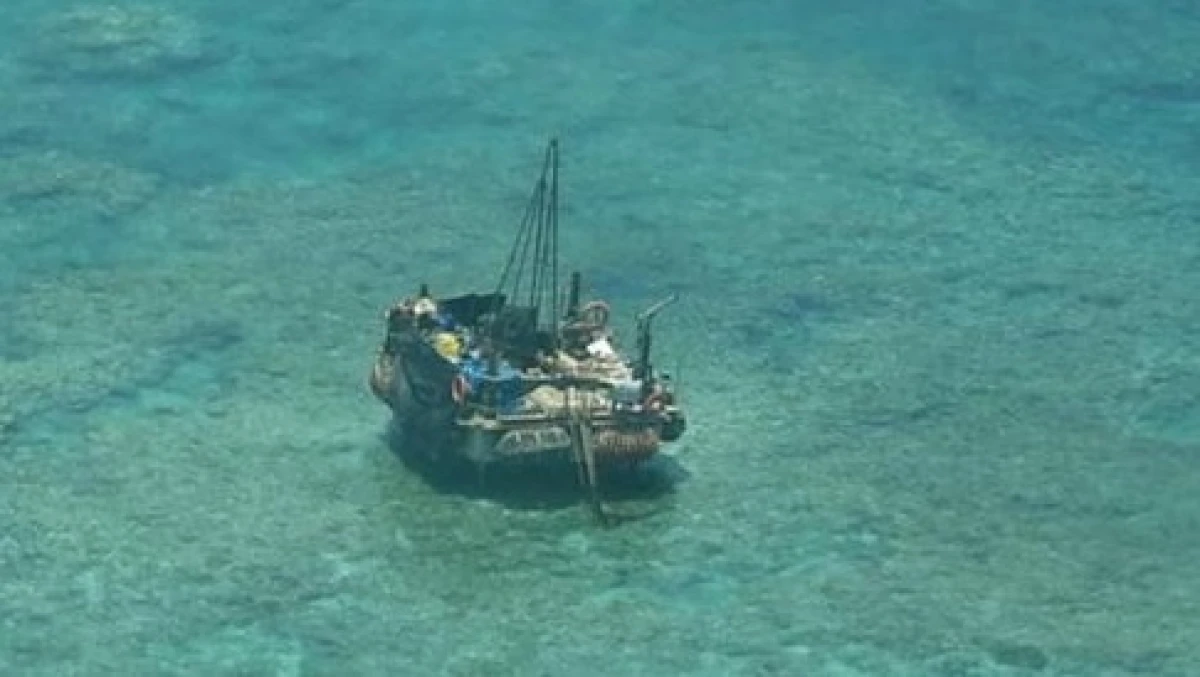
The two states have quarreled over a research platform.
The platform itself, at first glance, does not appear to be anything unusual. A small metal platform six by six meters, which barely accommodates half a dozen people. The only notable equipment on it resembles an antenna and signal buoys that the platform's crew has placed around it.
Despite this, the discovery sparked a strong reaction in Manila. The Philippine Foreign Ministry issued a diplomatic protest to China and sent a note demanding the immediate removal of the platform from Scarborough. Philippine lawmakers viewed the placement of such structures as an encroachment on the country's sovereignty and territorial integrity. The military promised to enhance patrols in the area and prevent the emergence of new Chinese structures on the reef.
In response, representatives of the People's Republic of China stated that the platform is intended for scientific research, and China has every right to conduct it, as it considers the reef and adjacent waters its sovereign territory. Beijing accused Manila of provocation. As a retaliatory measure, it imposed sanctions against Philippine Defense Minister Gilberto Teodoro Jr., who referred to the installation of the platform as "illegal expansion" and "international hooliganism." The minister himself responded that the bans do not concern him, as he had no plans to visit China anyway.
Manila's sharply negative reaction to the appearance of the platform did not arise from a vacuum. Scarborough is a small reef located relatively close (200 km) to the Philippine coast and is considered part of its exclusive economic zone (EEZ). However, in 2012, China effectively took unilateral control of it, which marked the beginning of the standoff.
While pro-China President Rodrigo Duterte was in power in the Philippines, the conflict remained in a smoldering phase. Manila did not raise complaints against Beijing, and in return, the Chinese side did not interfere with Filipinos fishing on the outer contour of the reef. The situation changed dramatically when Duterte's successor, Ferdinand Marcos Jr., sought closer ties with the U.S. and revived the dispute.
In 2024, the Philippines passed a law on maritime zones, which officially designated Scarborough as national territory. China did similarly, drawing its own maritime boundary around the disputed reef. Since then, clashes between Chinese and Philippine vessels have occurred regularly. In September 2025, Beijing went further: it declared Scarborough a national nature reserve, which formally gave it the right to begin constructing the corresponding infrastructure in the region — a move that Manila also perceived negatively.
Moreover, there was a very serious reason for this. In the 1990s, a similar conflict occurred between China and the Philippines over Mischief Reef, which is located much further south in the disputed Spratly archipelago. It all began when Chinese fishermen set up huts on Mischief. In the following years, an entire artificial island with a military base grew around them, where strategic bombers of the PRC are now stationed.
The Philippines fears that Beijing will attempt to pull the same trick at Scarborough. And if it is not stopped now, in a few years, the country will have another fortified Chinese outpost right next door.
The main problem for the Philippines, both in the 1990s and now, is the lack of ability to forcibly stop Beijing's expansion in the South China Sea. The military and economic potential of the two countries is incomparable, which is why Manila is trying to address the issue primarily on international platforms.
Right now, the main trump card in its hand is the 2016 ruling of the Hague Arbitration, which deemed 90% of China's claims in the South China Sea to be unfounded. In the same ruling, the court established Scarborough's status as a maritime object that does not grant rights to its own exclusive economic zone.
Another hope for the Philippines is the Code of Conduct in the South China Sea, which is being discussed between the PRC and ASEAN. The idea for the document originally emerged in 2002 as a way to at least slow down Beijing's creeping advance within the nine-dash line in the South China Sea. The development of the document has been ongoing for over two decades, largely due to China's extensive list of demands, which does not want to take on legal obligations and requires a clear mechanism for conducting naval exercises in the region involving third countries.
Starting January 1, 2026, the Philippines will take on the leadership of ASEAN and has since been trying to accelerate the development of the document. At their initiative, the negotiations have been moved to a weekly format. Marcos Jr. is trying to engage ASEAN countries more deeply in the process, offering them an agenda focused on trade protection and critical infrastructure in the region. Manila hopes to conclude the negotiations by the end of the year, which would help somewhat alleviate the pressure from the Middle Kingdom.
However, not everyone believes in the success of this endeavor. The fact is that ASEAN is a loose bloc that operates on the principle of consensus. The Philippines and Vietnam, which have the most conflicts with China, are interested in the swift development of the code. At the same time, their zeal is tempered by Laos and Cambodia — they have no disputes with Beijing but are economically dependent on it. Because of this, the Philippine Defense Minister has suggested completely abandoning the code of conduct and resolving issues based on existing international maritime law. However, this would be a direct path to escalating the conflict.
In addition to attempts to find a solution through ASEAN, the Philippines are also seeking assistance from other major powers. Today, Manila's main ally is undoubtedly the U.S. Washington has supported the country in the Scarborough dispute, and in January of this year, it demonstratively conducted joint exercises with Philippine military forces near the reef. A more tangible step is the allocation of $144 million to Manila for military infrastructure modernization, as well as the provision of the latest NMESIS anti-ship missiles capable of striking Chinese vessels from the shores of the islands.
Recently, Japan has also actively engaged in the standoff. On April 20, the country participated for the first time in the U.S.-Philippine military exercises Balikatan 2026 as an active participant rather than just an observer. At the end of May, Tokyo announced that it would transfer six decommissioned Abukuma-class destroyers to Manila so that the Philippines could more effectively counter China at sea.
In the People's Republic itself, the rapid rapprochement between the Philippines and Japan has not gone unnoticed. Beijing reacted very harshly to the recent plans of the two countries to conduct a delimitation of maritime boundaries. Following the announcement, China accused them of violating the Convention on the Law of the Sea and announced the start of a "special maritime operation" to patrol waters east of Taiwan.
Support for the Philippines at sea is also demonstrated by Australia and France, but to a lesser extent. Canberra's participation is currently limited to joint patrols. The legal basis for this has been prepared by Paris, which has concluded an agreement with Manila allowing it to use Philippine ports as supply bases.
Despite solid support from abroad, it is unlikely that the Scarborough reef will lead to a direct confrontation between Beijing and the anti-Chinese coalition. It is more likely that neither side will dare to escalate. And China will continue to successfully implement its "salami slicing" tactic — taking many small steps until it reaches its set goal.
Beijing is unlikely to heed the protests and will not dismantle the ill-fated platform inside Scarborough Lagoon. In the coming years, this structure will accumulate new modules, be reinforced with concrete, and gradually turn into a stationary military or police observation post.
Manila will sound the alarm, transport journalists to Scarborough, and submit notes of protest, while its allies will conduct regular exercises nearby without moving to decisive actions. Thus, Beijing will slowly but surely achieve its goal: to create a permanent outpost on Scarborough Reef, once again changing the status quo in its favor without a single shot fired.















Leave a comment