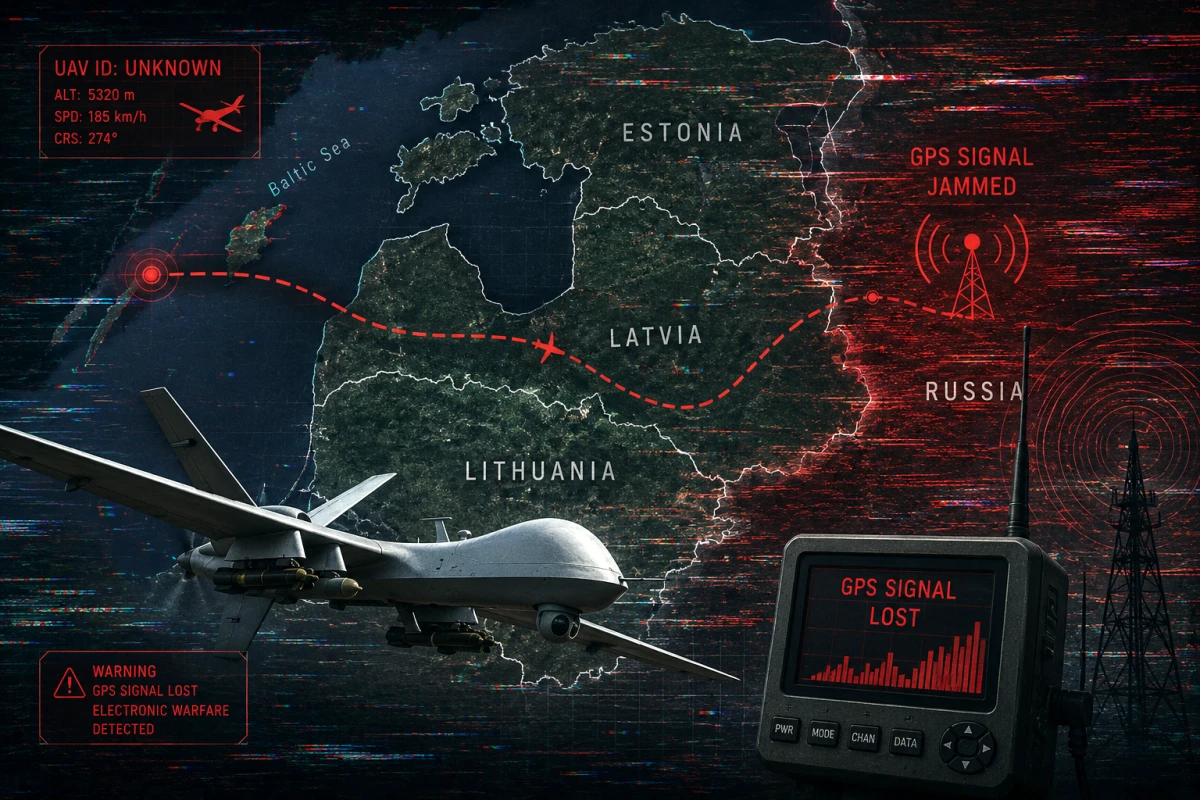
After a series of incidents involving drones in the Baltic states and Finland, experts explained the possible mechanism by which Russia may redirect Ukrainian drones towards NATO. This involves the widespread use of GPS jamming and the substitution of navigation signals.
Russia may redirect Ukrainian drones towards the Baltic states and Finland using electronic warfare and fake GPS signals. Several navigation and security experts told the British newspaper The Telegraph, as reported by nra.lv.
In recent weeks, unidentified drones have been regularly detected in the airspace of the Baltics. Against this backdrop, the authorities of Latvia, Estonia, and Finland have already begun warning residents about potential aerial threats.
According to experts, a powerful transmitter in Kaliningrad plays a key role in such operations. It is capable of completely jamming the GPS signal that the drone relies on.
When the drone loses contact with satellite navigation, it automatically begins searching for a new signal. At this moment, specialists claim, the mechanism of so-called "spoofing" — the transmission of false coordinates — is activated.
The fake signal turns out to be significantly stronger than the usual GPS, and the drone starts to perceive it as the real one.
As a result, the drone is "convinced" that it is supposedly deeper within Russian territory than it actually is. In trying to return to its designated route or base, the device changes direction and heads west — towards NATO countries.
This is how drones can end up over Finland, Estonia, or Latvia.
Additionally, Russia can interfere with the drone's internal systems. Ramsey Faragher, director of the British Institute of Navigation, explained that it is possible to distort the time codes in the drone's onboard computer. According to him, the system may start to "think" that, for example, ten years have passed. This leads to malfunctions, reboots, or complete loss of control during flight.
Experts believe that the problem will only intensify. Chatham House analyst Kir Giles noted that such operations cost Moscow virtually nothing, yet create a serious effect.
"Russia has no reason to stop: these actions cost Moscow nothing and have no consequences, yet the effect is enormous," he stated.
Ukraine is already trying to find ways to protect against such electronic warfare methods. For short-range drones, one solution is to use a fiber optic cable that the drone tows behind it, which cannot be jammed by GPS interference.
Another option is to use artificial intelligence and autonomous navigation systems that allow the drone to navigate without a satellite signal.
The topic is being actively discussed following recent incidents in the Baltics. Last Tuesday, residents of several regions in Latvia received warnings about potential threats in the airspace.
On the same day, an F-16 fighter jet of the Romanian Air Force, participating in NATO's Baltic patrol mission, shot down a drone over Estonia. The operation was coordinated by the Latvian Air Force's Command and Control Center.
According to Estonian authorities, the drone was intercepted near the municipality of Põltsamaa after visual confirmation of the target.
A series of such incidents shows that electronic warfare is gradually becoming one of the main threats to the region's airspace — even without the direct use of missiles or aviation.