"I do not believe that Russia is currently capable of acting on two fronts."
Carlo Masala is a publicist, professor at the Bundeswehr University in Munich, and one of the most well-known experts in Germany in the field of security policy. The author of the book "If Russia Wins. A Scenario" spoke to Deutsche Welle about the consequences of the war in Iran for Ukraine and the threats to NATO in Europe.
DW: - The USA and Israel are at war with Iran, and this ties up American armed forces. This is essentially what you describe in your book, only your scenario involves China’s "diversionary maneuver" in the Pacific region and Russia’s operation in Europe. Perhaps now is a favorable moment for Russia to test NATO?
Carlo Masala: - I do not believe that Russia is currently capable of acting on two fronts. Right now, it has a more favorable moment to achieve its goals in Ukraine. Then they will give themselves a little more time to do everything else. Because NATO is currently in a situation where the Americans have made it clear that they will no longer be the main guarantor of conventional arms in Europe. This should be the responsibility of Europeans. Thus, part of Russia's goals to split NATO has been achieved because the USA is reducing its active role in the defense of Europe. And this, of course, increases the likelihood that Russia will carry out a military provocation and test the resolve of the alliance. At this point, I consider this relatively unlikely, although I do not completely rule it out.
That is why the war with Iran is bad news not only for Ukraine but also for Europe in the context of hybrid warfare. Russia has lost a significant part of its global influence over the past eight months: Venezuela, Syria, and now Iran as well. Regardless of the outcome of the conflict, Iran will weaken and, consequently, will no longer play the strong role for Russia that it played in the past. And now Russia ultimately has only one playing field left, so to speak. And that is the European playing field. From Russia's perspective, it is the most important. Russia may now act even more aggressively on this last, most important playing field.
- In your book, you described a scenario in which Russia occupies part of NATO territory - Estonia. In 2025, Russia sent about 20 drones to Poland, which were shot down by NATO fighters for the first time. Why wouldn’t Russia send 100 or 200 drones to different countries now, and then NATO wouldn’t be able to cope with it, or would it?
- Yes, NATO would not be able to cope with it, but it still would not be a case of invoking Article 5 of the NATO treaty. That is the essence of it. An armed attack must be carried out continuously. Therefore, if Russia were to attack Poland with 100 drones for seven consecutive days, then that would be a case for invoking Article 5, and it would have to be activated. But this policy of "targeted impact" that Russia is pursuing - drones in Poland, fighters in Estonia, sabotage, espionage elsewhere - is not a situation that falls under Article 5. And that is why it differs from the scenario I described in the book. Perhaps there is a calculation in Moscow, especially considering the violations of airspace by fighters, that NATO will decide to shoot down one of these aircraft. Russia could then declare it a provocation and respond with its actions.
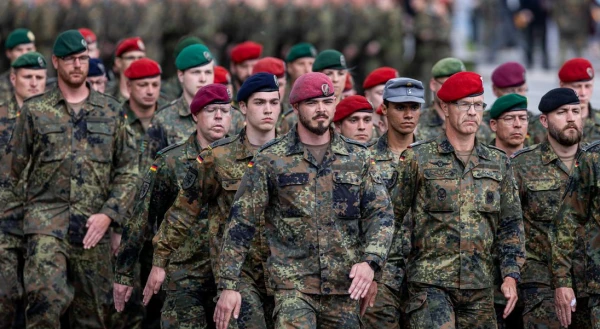
- In December 2025, a military exercise simulating a Russian attack on Lithuania, where a German tank brigade is stationed, was conducted at your Bundeswehr University. The result: the "Russian team" achieved a quick victory, partly because the "German team" showed indecisiveness. And this is not surprising. Germany is considered politically indecisive and militarily weak, even within NATO. Is this changing or remaining the same?
- Militarily, we are on the path to strengthening and taking the necessary steps. The essence is that politically we are very restrained. And yes, I would not rule out the possibility that Germany will be one of the countries that will very reluctantly go for invoking Article 5. Thus, the situation is this: political indecisiveness will remain, yes, while military weakness is changing to strength.
- The Lithuanian tank brigade of the Bundeswehr is supposed to be ready for deployment in 2027. Currently, we hear about difficulties in staffing, there are not enough volunteers. Why is that?
- Because all the infrastructure in Lithuania is not yet ready. The idea is that people will be stationed there for three years, if I understand correctly. And, of course, it is assumed that they will bring their families. But the infrastructure for families, in particular, has not yet been created. This is what prevents people from going to Lithuania. It has not been clear so far how everything will be organized for those going to Lithuania alone, how flights back to families will be arranged. These issues are only now being resolved. So the whole situation has been unclear. And I think this has contributed to the indecisiveness. The second point, and this must be said, is that the army operates on the principle of command and control. From the very beginning, I did not understand why they simply did not station troops there.
- The Lithuanian brigade is also supposed to be protected by drones. Orders are being placed these days. Is protection against drones NATO's biggest weakness in Eastern Europe?
- I would say that air defense and counter-drone measures are the biggest weakness, yes. We see problems, we have received reports, and I believe they are accurate. There was news that, it seems, in Estonia in 2025, a Ukrainian unit of drone operators was invited to test how well NATO troops respond. And this relatively small Ukrainian unit was able to completely incapacitate two battalions, as far as I remember, in a few hours. And that just shows how weak we are in this area.
- The Bundeswehr is now inviting Ukrainian instructors to Germany. They are expected to be involved in artillery, engineering, armored operations, and drone deployment. Why only now, four years into Russia's full-scale war against Ukraine?
- That is a good question. I think it is because for a long time people did not want to admit that a state in need of military support for self-defense actually turned out to be able to protect itself better than all the NATO armies combined, which, in essence, practiced this only theoretically. I think it has finally become clear that the Ukrainian armed forces have been battle-tested, therefore they know where the weak points are that we only identify during theoretical exercises, but which we cannot detect because we do not practice in real conditions.
- What could or should the Bundeswehr learn from Ukraine?
- I believe that the most important thing the Bundeswehr should learn from Ukraine is how to integrate technological innovations at the lowest levels. We still have a very hierarchical structure, top-down. And now it is quite unthinkable for us to grant a unit, for example, a platoon, decision-making authority regarding technological innovations. And I believe that this is what we need to learn from Ukraine. That is, to delegate responsibility even lower, because that is where they know what is needed and what is not. Allow people at lower levels to experiment with drones, if they find that the drone is not working as intended, but if they do something differently, then the drone simply becomes more effective. None of this aligns with our culture. And I believe that this is what we can learn from Ukraine.