
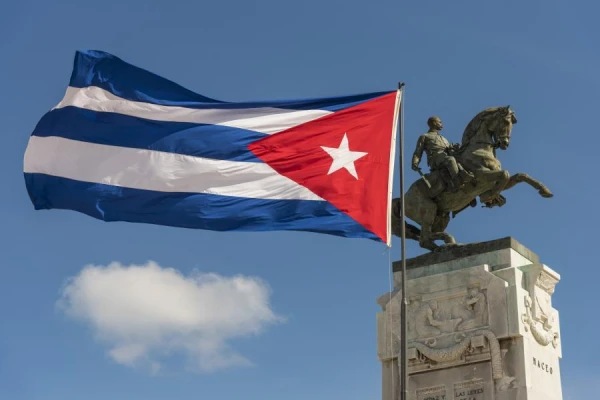
The second country affected by the operation to capture Maduro, after Venezuela, was Cuba. Havana reported that 32 of its citizens—members of the Cuban armed forces and intelligence services—were killed in Caracas.
The country has lost a key political ally, the backbone of its troubled economy, and received warnings from Washington that it could become the next target.
Friendship with the Smell of Oil
The presence of Cuban military personnel in Venezuela is a vivid example of the close cooperation between Havana and Caracas, said Bert Hoffmann, a political scientist from the German Institute for Global and Regional Studies, in an interview with Euronews. "Venezuela has been Havana's most important political ally since Hugo Chavez and Fidel Castro began their close friendship in the early 2000s," he recalled.
In 1999, Chavez, then a presidential candidate, met in Havana with the leader of the Cuban Revolution, Fidel Castro, and in the following decades, their alliance only deepened. Maduro was educated in Cuba and positioned himself as the guardian of Chavismo, an ideology shared by Havana.
As a result, Cuban officials began to occupy key positions in Venezuela's intelligence apparatus, and Havana sent doctors and medical personnel to Caracas in exchange for political support and cheap oil. Over the past few months, Venezuela has been supplying Cuba with about 35,000 barrels daily at heavily discounted prices. According to Hoffmann, the retention of Venezuelan oil is a kind of lifeline for the island.
In Havana, there are justified fears that the U.S. could overthrow the Cuban regime without direct intervention by completely cutting it off from Venezuelan oil. Our channel's source believes that in the current situation, further support for Cuba is unlikely to be a priority for the new leadership in Venezuela.
The island of freedom may seek alternative supplies from Russia, Iran, or Arab countries, but direct assistance to Havana would make any new supplier a potential target for U.S. reprisals, says Hoffmann.
Cuba is already experiencing the deepest economic crisis in its recent history. In recent years, the country's economy has shrunk by about 4%, with a 1.5% decline expected in 2025 alone. Inflation exceeds 20%, and there is a widespread shortage of food, medicines, and fuel.
Oil prices fluctuate after the U.S. seized Nicolás Maduro. Investors turn to safe-haven assets. "Economically, Cuba is paying dearly for focusing all its investments on tourism—a sector that is extremely toxic to any crises and political uncertainty," notes the expert.
A Thorn in America's Side
Hoffmann reminds us that the elimination, undermining, or at least isolation of Cuba's communist regime has been a priority for America since the Cuban Revolution of 1959, and for Trump, the removal of Maduro represents an opportunity to achieve this. "Cuba seems to be about to fall. I don't know how they, if at all, will manage to stay afloat, but Cuba currently has no income. All their income came from Venezuela, from Venezuelan oil," President Trump stated recently.
However, according to Hoffmann, despite the events in Venezuela, the leadership in Havana is still afloat. "The fear of what will happen after a possible regime collapse is a powerful glue for uniting the elite," the expert believes. "They will closely monitor how Maduro's circle survives the storm, whether they will be hanged from lampposts."
According to U.S. Secretary of State Marco Rubio, a descendant of Cuban exiles, politicians in Havana should not rest easy. "If I lived in Havana and was in the government, I would be a little worried," he said in an interview with NBC News over the weekend, declining to elaborate on U.S. plans regarding Cuba.
One possible scenario is a complete naval blockade, for which the Cuban army is already prepared, and according to Hoffmann, this will not drive the Cuban people into the streets. "Even if living conditions become even harsher, this does not necessarily lead to an uprising," he believes. "Mobilizing collective action requires not only general discontent but also faith that protest can lead to change.





Leave a comment