
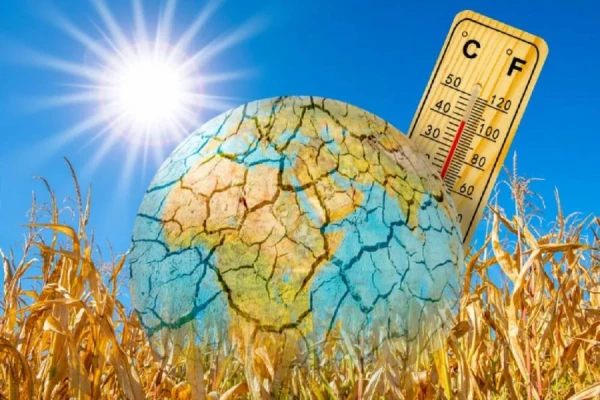
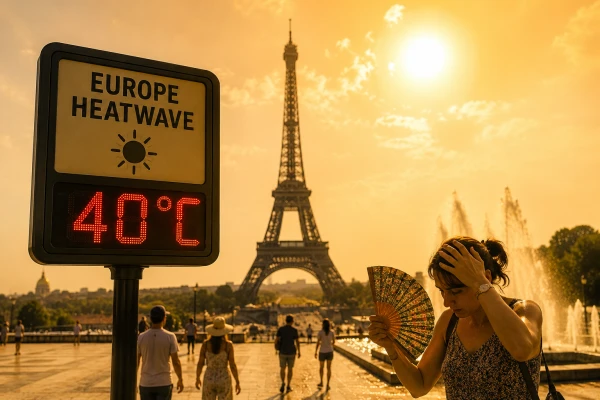
Climate change caused by human activity has made 2025 one of the three hottest years in the history of meteorological observations, writes The Washington Times.
According to scientists, for the first time, the average global temperature over three years has exceeded the limit set by the Paris Climate Agreement of 2015 - no more than +1.5 °C above pre-industrial levels.
Experts emphasize that adhering to this limit could save thousands of lives and prevent large-scale ecological disasters in various regions of the world.
It is noted that a new analysis by researchers from World Weather Attribution (WWA), released in Europe, came after a year marked by a wave of destructive weather anomalies across the planet.
Despite the influence of the La Niña phenomenon - a natural process that cools the waters of the Pacific Ocean and usually lowers global temperatures - the heat in 2025 remained extremely high. Scientists attribute this to the continuous burning of fossil fuels: oil, gas, and coal, which emit greenhouse gases into the atmosphere.
"If we do not stop burning fossil fuels very quickly and soon, it will be extremely difficult to keep global warming within the target," said WWA co-founder and climate scientist at Imperial College London, Friederike Otto.
According to WWA, extreme weather events claim thousands of lives and cause billions of dollars in damage each year. In 2025, scientists identified 157 severe climate events - those that led to at least 100 deaths. These calamities affected more than half of the population of a given area or led to the declaration of a state of emergency. A detailed analysis was conducted on 22 of them. The deadliest were heatwaves. Researchers estimate that some of the heat anomalies of 2025 became ten times more likely than they were ten years ago, precisely because of climate change.
"Such heatwaves are now commonplace in our climate, but without human influence, they would have been nearly impossible," noted Otto.
Prolonged droughts contributed to widespread wildfires in Greece and Turkey. In Mexico, heavy rains and floods claimed the lives of dozens of people, with many more missing. Super Typhoon "Fung-wong" struck the Philippines, forcing the evacuation of more than a million residents. In India, monsoon rains caused catastrophic floods and landslides.
WWA warns: the frequency and intensity of extreme events increasingly exceed societies' ability to adapt. An example is Hurricane "Melissa," which intensified so rapidly that it complicated forecasting and preparation. The impact of the storm on Jamaica, Cuba, and Haiti was so severe that the countries could not effectively cope with the aftermath.
Politics Lags Behind Science
The UN Climate Summit in Brazil, held in November 2025, concluded without a clear plan to phase out fossil fuels. While countries promised more funding for climate adaptation, implementing these commitments takes time.
Experts acknowledge: exceeding the +1.5 °C threshold is now almost inevitable, although some scientists believe that a reversal is still possible.
At the same time, progress in different countries is uneven. China is actively developing solar and wind energy but is simultaneously investing in coal. In Europe, extreme weather has tightened demands for climate action, yet some individual states view this as a threat to economic growth. In the United States, the Trump administration, on the contrary, moved away from clean energy policies in favor of supporting the oil, gas, and coal industries.
"The geopolitical weather is very grim right now: many decisions are made in the interests of the fossil fuel industry rather than the population," summarized Friederike Otto.
Senior researcher at Columbia University's Climate School, Andrew Kruchkevich, adds: the world is increasingly facing disasters for which it was unprepared, and extreme events are becoming more complex and faster. This requires earlier warnings and new approaches to response.
"There is some progress, but it is still not enough," he says.
The World is Closer to Global Catastrophe
It is worth noting that the Doomsday Clock has dangerously approached midnight after a year marred by conflicts, environmental disasters, and political upheavals. This metaphorical clock was created in 1947 by scientists working on the infamous Manhattan Project and serves as a sobering indicator of how close humanity is to its own demise. As the hands of the clock creep toward the final hour, midnight symbolizes an irreversible point of no return for civilization. According to researchers, it is now frozen in the most dangerous position in history.








Leave a comment