
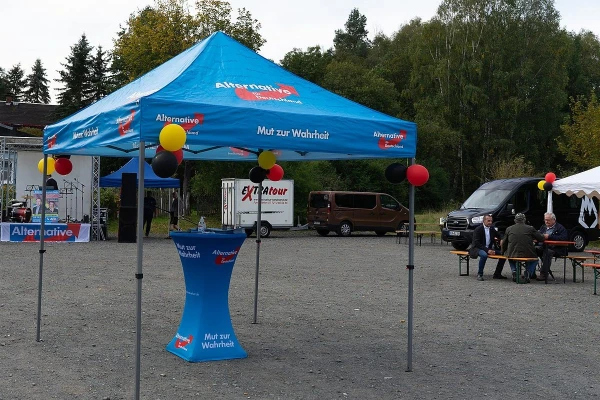
Leftist politics has suffered a loss.
Leading sociological institutes in Germany — Forsa, Infratest dimap, Insa, and others — regularly conduct the so-called "Sunday question" (Sonntagsfrage). The latest party ratings in Germany show sharp shifts in voter preferences for 2026. Let's analyze what has changed.
Respondents are asked which party they would vote for if elections to the Bundestag were held next Sunday. Based on this data, Redaktions Netzwerk Deutschland (RND) calculates the average rating from the last ten polls on a daily basis.
As of February 21, 2026, this averaged rating looks as follows: Union — 25.5%, AfD — 25.0%, SPD — 15.4%, "Greens" — 11.7%, Die Linke — 10.2%, BSW — 3.6%, FDP — 3.2%.
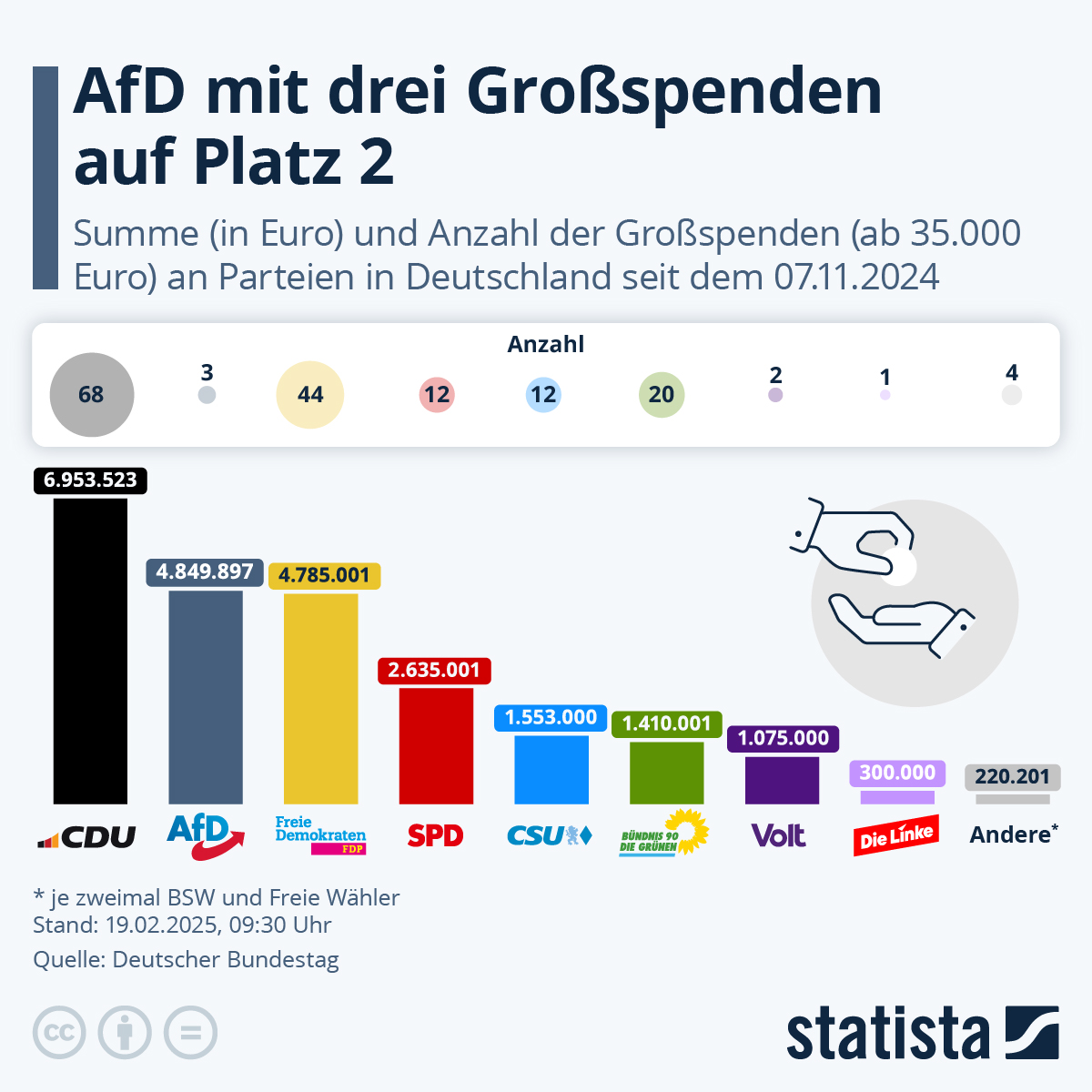
According to Forsa data from February 17, the numbers are close: Union — 26%, AfD — 25%, SPD — 14%, "Greens" — 12%, Die Linke — 10%, FDP and BSW — 3% each.
BSW ("Alliance of Sahra Wagenknecht") was literally a step away from entering the Bundestag: 4.98% — just below the required five percent threshold. FDP also did not overcome this barrier, gaining 4.3%. This was a serious blow for both parties.
Today, the situation is noticeably different. The main change is the reduction of the gap between Union and AfD to a minimum. Meanwhile, AfD has gained more than four percentage points compared to the election results. Union, on the contrary, has lost about three points.
Long-term dynamics help to understand how the current situation has formed. After the 2021 elections, SPD held the position of poll leader for some time but soon ceded the lead to Union. The "Greens" also experienced a brief rise after those elections.
However, they then lost a significant portion of support.
The third party of the then "traffic light" coalition — FDP — moved down for an even longer time. In the 2025 elections, this downward trend ended in failure: the party did not pass the five percent barrier. According to current data, FDP remains at the level of 3–3.2% and shows no signs of recovery.
The main beneficiary of the losses of the coalition parties has been AfD. In mid-2023, it rose to the second spot in the rankings for the first time. In early 2024, AfD lost some positions but then began to gain points again. Now, the "Alternative for Germany" is effectively on par with Union. The dynamics of Die Linke is noteworthy. In the 2025 elections, the party received 8.8%, and now its rating in polls has risen to 10–10.2%. This is a significant increase, especially considering that a few years ago the party was in a deep crisis.
BSW, which first appeared in polls in early 2024, stopped just at the threshold of the Bundestag during the elections.
In current measurements, the averaged rating of Sahra Wagenknecht's party is 3.6%, while according to Forsa it is 3%. This is significantly lower than the election result (4.98%). The loss of voter interest in this project is evident.









Leave a comment