
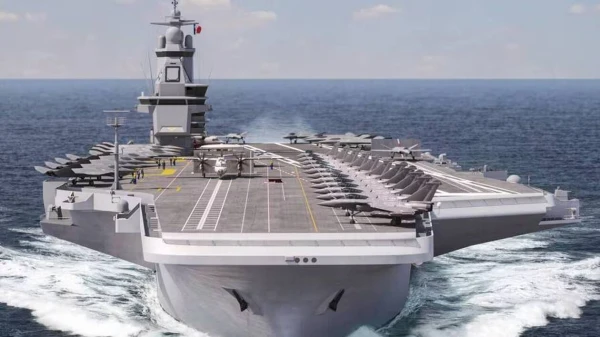
The electromagnetic catapult system will be used for the first time on the ship.
Emmanuel Macron made a loud statement about the construction of a new aircraft carrier in Abu Dhabi, the capital of the UAE.
The president hosted a Christmas dinner for more than 900 French military personnel. The French military has a significant presence in the UAE: a frigate, aviation, and soldiers are carrying out their mission in this strategically important region.
During the ceremonial part of the event, Macron sang the Marseillaise with the military and made a loud statement about the construction of a new aircraft carrier, which will replace the "Charles de Gaulle."
"We must be strong so that we are feared, especially at sea. That is why, in accordance with the last two laws on nuclear programming and after careful and thorough analysis, I have decided to equip France with a new aircraft carrier," said the head of the French state during the traditional Christmas celebration with the troops.
The new aircraft carrier, already dubbed the "floating monster," will be commissioned in 2038. With its impressive size — 310 meters long and a displacement of 80,000 tons — it will significantly surpass the "Charles de Gaulle." This will allow for a crew of 2,000 sailors and up to 30 fighter jets.
The cost of the aircraft carrier will be equally impressive. Preliminary estimates suggest it will cost France at least 5 billion euros and up to 10 billion euros.
Such a high cost is explained by the advanced technologies that will be used in it. These include the Electromagnetic Aircraft Launch System (EMALS), which will nearly double the number of sorties compared to the "Charles de Gaulle," as well as vertical launch Aster missiles, close-in weapon systems, including remotely operated artillery, and the Thales Sea Fire radar, capable of tracking up to 1,000 targets simultaneously.
The aircraft carrier will have a flight deck area of 17,200 m² compared to 12,000 m² of its predecessor and a hangar area of 4,500 m², which is 1,000 m² larger than that of the "Charles de Gaulle." The driving force will be two K22 nuclear reactors, allowing it to reach speeds of about 50 km/h.
The first steel cutting work is scheduled for around 2031 in Saint-Nazaire, with construction stretching over four to five years, followed by sea trials. Commissioning is expected in 2038.







Leave a comment