
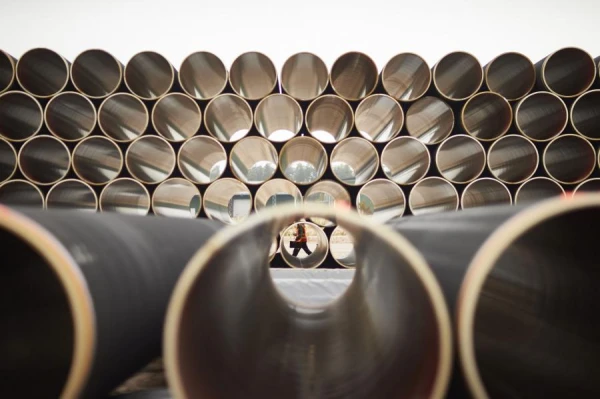
Support for the European economy and the concept of 'Made in Europe' will be the central theme of the EU leaders' summit taking place on Thursday in Belgium.
European Commission President Ursula von der Leyen advocates for "European preferences" in strategic sectors of the economy. In particular, she proposes to introduce a mandatory requirement for companies receiving government funding in these areas to purchase components produced in Europe. This protectionist step, aimed at strengthening the EU's industrial base, is supported by France. Germany, however, has expressed concerns about the initiative.
"Europe must be able to protect its strategic interests and actively support" its own manufacturing base, and "European preferences are a necessary tool to achieve this goal," the European Commission President stated.
At the same time, von der Leyen added: "I want to clarify - this is a fine line that must be walked." According to her, there is no "one-size-fits-all solution." That is why every proposal must be backed by "reliable economic analysis and comply with international obligations."
Support for the European economy and the concept of "Made in Europe" will be the central theme of the EU leaders' summit taking place on Thursday in Belgium. Debates on this topic in the EU will occur against the backdrop of economic stagnation, the imposition of tariffs by the U.S., and aggressive trade practices by China.
The French President is an Advocate of the 'Buy European' Concept
The sharp increase in government spending in the bloc over the past year, including a program to increase defense spending by €150 billion and a €90 billion loan to support Ukraine, has heightened concerns that foreign companies, rather than domestic ones, will benefit.
French President Emmanuel Macron has long been a staunch supporter of European preferences, also known as "Buy European."
In an interview with European media ahead of the summit on Thursday, Macron stated that this point is a "protective measure" against those who "no longer respect" trade rules.
"We must protect our industry. The Chinese do it, and the Americans do too. Currently, Europe is the most open market in the world. In this context, the solution is not protectionism, but consistency, meaning not imposing rules on our producers that we do not impose on non-European importers," Macron said.
"We will not apply European preferences to mobile phones; we no longer produce them in Europe. We must focus on certain strategic sectors such as clean technologies, chemicals, steel, automotive, and defense. Otherwise, Europeans will be left behind."
Mario Draghi, former President of the European Central Bank, who will attend the summit on Thursday, also supported the concept of "European preferences."
Sharp Debates
France's position has met with strong resistance from the Netherlands, Northern European countries, and the Baltics, which argue that the concept of "European preferences" will lead to increased regulatory burdens, market closures, and deter investors.
"The main idea of protecting European businesses (if that is the goal of the 'Buy European' campaign) is to avoid trading or partnering with other countries. I am very skeptical about this," Swedish Prime Minister Ulf Kristersson stated in an interview with the Financial Times ahead of the summit.
"We must be able to compete based on quality and innovation, not because we are trying to protect European markets," he added. "We do not want to protect European companies that are fundamentally uncompetitive."
Meanwhile, Germany advocates for a broader concept of "Made with Europe," which would encompass "like-minded" countries and those that have signed trade agreements with the EU.
The EU leaders' meeting in Belgium is designed as an informal event allowing politicians to engage in free conversation. No written conclusions or formal decisions will be made.
According to a senior EU official, the agenda will include the issue of "European preferences."
"From discussions with leaders, we have understood that more and more of them, possibly all, are ready to discuss this issue. Perhaps the balance is not what it used to be. Some do not want European preference to be applied universally," the official said. "But this is an important discussion. A few years ago, it would not have generated the same consensus," the source noted.











Leave a comment