
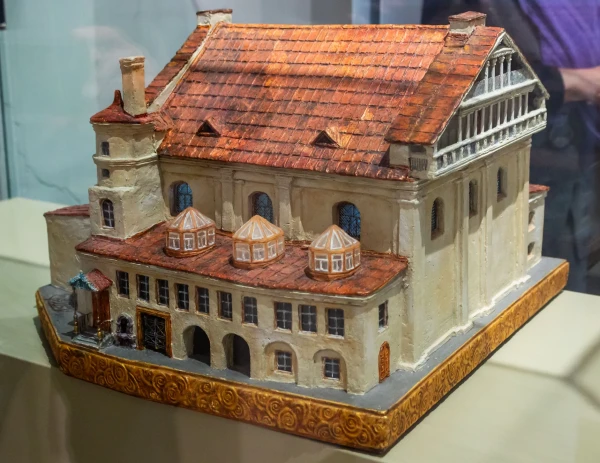
This is a unique opportunity to get acquainted with the house of prayer that no longer exists.
Hanukkah at the Museum of the Culture and Identity of the Jews of Lithuania was special: a model of the Vilnius Great Synagogue was presented, visually recreating the most important and impressive Jewish sacred building that once stood in Vilnius on Vokiečių Street.
Today, only fragments of the synagogue's cellars and floors remain, while the model allows one to see its architectural integrity. This is a unique opportunity to get acquainted with the house of prayer that no longer exists and to approach the history, the memory of which is now preserved only thanks to the remaining archaeological finds and works of art.
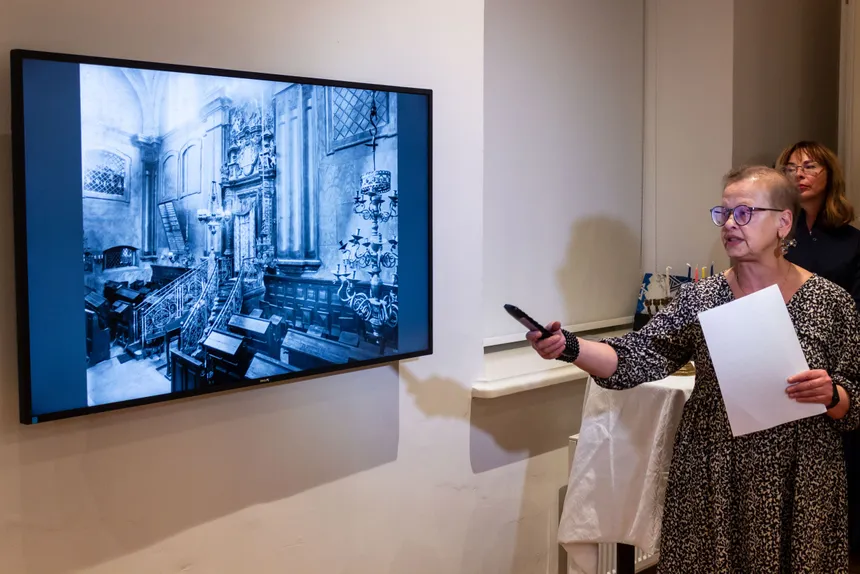
The model was presented by Anna Avidan, the author of the idea for its creation. She spoke about the reasons that prompted the realization of this idea, the difficulties and discoveries that accompanied the process of its development, and what makes it special.
During the event, the head of the Center for Jewish Studies at the National Library, Dr. Lara Lempertėne, spoke about the Great Synagogue as a place where the social life of the Jewish community was concentrated.
The model was exhibited alongside the most valuable exhibits of the museum – relics of the Vilnius Great Synagogue, which were complemented by historical recordings of cantorial singing.
The first wooden synagogue was built on Jewish Street in 1573. It was destroyed during the pogrom of 1592. In 1606, the synagogue was rebuilt.
In 1630, Jews received permission to build a stone synagogue, on the condition that it would not be higher than the Vilnius churches and would not stand out in style from other buildings in the area. The architecture of the building was very simple. The exterior was decorated with pilasters, the windows were pointed, and the roof was adorned with an attic, which was characteristic of the Renaissance style. The interior vaults, decorated with geometric ornaments, were supported by four Tuscan columns. The bimah was originally located at the eastern wall but was later moved to the center of the hall. The Aron Kodesh was adorned with gold and silver.
The synagogue was damaged several times. During the occupation of Vilnius by Russian troops in 1655, it was burned by the Russians. In 1748, a fire destroyed part of the synagogue, the women's gallery, and the bimah. Once again, the synagogue was damaged during the Kościuszko Uprising in 1794. There is a legend that the Vilna Gaon took a Torah scroll from the Aron Kodesh at night and read it seven times. As a result, a Russian shell fired at the synagogue did not explode.
After the Kościuszko Uprising, the synagogue was restored in the style of classicism. The upper gallery was supplemented with a Corinthian portico. The synagogue was the most important element of the complex on Jewish Street. Next to it was a library founded in 1886 by Mates Strashun. The library also housed the archive of the Vilnius Jewish community. In 1927, the library had 19,000 items. There were also four rooms for studying the Torah nearby. The synagogues of the Gaon and Chevra Kadisha were also located nearby. The complex also included a mikvah.
During World War II, when the Nazis and local collaborators exterminated almost all the Jews, the synagogue was used by the Germans as a grain warehouse. In July 1944, it burned down during the battles for Vilnius. The roof of the building was completely destroyed, the interiors were burned out, but the walls remained standing. However, the new authorities of Vilnius did not agree to restore the synagogue.
In 1953, a general plan for the construction of Vilnius was adopted, which provided for the reconstruction of the old Jewish quarter. Between 1955 and 1957, the ruins of the synagogue were demolished, and a school was built in their place. Currently, a two-story brick building stands on the site of the synagogue, assigned the address: Vokiečių St. 13a, which houses an elementary school.
In 1999, episodes of the film "The Devil's Arithmetic" were filmed on the site adjacent to the area where the old synagogue stood, including the episode of the synagogue's burning. Although the film's action takes place in a completely different location, the site chosen for filming is very symbolic.
In 2002, a project for the restoration of a fragment of the former Jewish quarter in Vilnius was proposed, including the Old Synagogue.









Leave a comment