
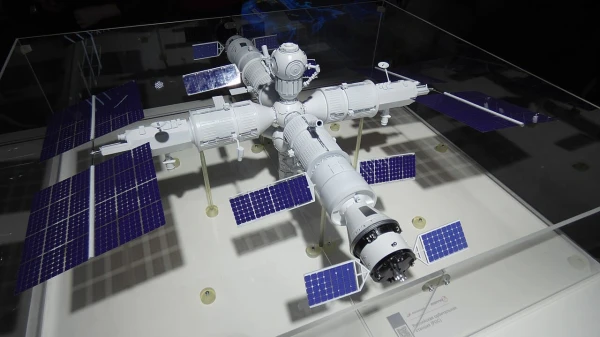
Scientists proposed rotation through the North Pole.
Since the 2010s, "Roscosmos" has stated that the future Russian Orbital Service Station (ROSS, sometimes referred to as ROS) will be able to fly over the pole, which will provide opportunities for new scientific experiments. However, shortly after Russia temporarily lost the ability to launch people into space in November 2025, this position changed.
During his visit to India, First Deputy Prime Minister Denis Manturov announced that the inclination of the future Russian Orbital Service Station (ROSS) will be 51.6 degrees. This is the same as the inclination for the future Indian orbital station and the ISS, although it differs from the inclination of the Chinese orbital station.
At first glance, the statement may seem unexpected. Just three years ago, Dmitry Rogozin, who was then heading "Roscosmos", stated in an interview: "We, together with the Academy of Sciences, have already considered the main outlines of the architecture of this Russian orbital service station, and we have determined the inclination of the orbit, which will provide us with a colossal amount of information." At that time, Rogozin indicated that the station would be automatic, and humans would only visit during the installation of "payloads".
"I have always advocated for a high-latitude orbit. Because in an orbit with an inclination of 51.6 degrees, everything is clear and has long been studied; we cannot continue to work within the framework of manned cosmonautics without forming a task that is fundamentally different from what has already been passed, what is already available in Soviet and Russian cosmonautics," he added.
In 2025, to clarify the "radiation risks" of the polar orbit, the biosatellite "BION-M3" was launched into it. This means that as early as the summer-autumn of this year, the polar orbit option was considered quite likely. A sharp change in rhetoric occurred only in November 2025 — that is, precisely in the month when Russia, due to an accident at the Baikonur cosmodrome, temporarily lost the ability to send people into space. So far, "Roscosmos" has not indicated a possible timeline for restoring the infrastructure.
Such a rapid change in position regarding the inclination of the future ROSS orbit, within a single autumn, is unlikely to be related to the data from "BION-M3". The fact is that the extent to which radiation is elevated over the polar regions of the Earth was measured deep in the 20th century, so there could not have been anything new scientifically.
However, the situation with the loss of the ability to launch people into space indeed provided valuable experience in terms of planning the future orbit of ROSS. As we have already written, in the 2010s, Russia abandoned a backup launch complex for manned launches. Under such conditions, having a station with people is better in those orbits from which it will be easier for foreign spacecraft, for example, American and possibly even Indian in the future, to conduct rescues.
But such a solution also has negative aspects. As noted by Academician Lev Zeleny back in 2022, the Russian orbital station in a polar orbit is more interesting for science. Among the advantages of a polar orbit, he particularly highlighted two: the ability for a global overview of the Earth, including all the territory of our country and the Arctic, which the ISS orbit does not allow, as it does not go above the latitude of 51.6 degrees. The second is polar geophysics, that is, research in the auroral zone, where atmospheric processes are still largely unexplored by science.
Another problem with the planned inclination: the launch cosmodrome. For launches to such orbits from Vostochny, a new astronaut rescue service needs to be created. After all, if their emergency rescue system works over water, the ship with people will need to be retrieved from the ice of the Sea of Okhotsk. This requires fundamentally new approaches, as traditionally our spacecraft have not been designed for landing in water, let alone in ice. Moreover, rescuing people from the ice means the need to keep rescue vessels there, and sometimes icebreakers (helicopters in stormy weather cannot always solve all tasks).
So far, no one has even started creating such a system. When ROSS was planned with a polar orbit, this was not a problem: with an inclination of about 90 degrees, our spacecraft would fly over land. But for an orbit with an inclination of 51 degrees, launching from Vostochny only over land is impossible; this can only be done from Baikonur. Thus, the new choice of orbit inclination for ROSS, announced by Manturov, means the continuation of manned flights from Baikonur. But how long-term such a decision is in light of various events that sometimes occur in Kazakhstan is not entirely clear.
Interestingly, the decision to abandon the orbital station with a polar orbit has been announced, but nothing has been said about the need to restore a backup site for manned launches.
In this situation, it is difficult to rule out that a decision has been made to continue without it. And in the event of new accidents blocking launches at alternative sites, to seek foreign assistance. The situation could be clarified by some public statements from "Roscosmos", but based on its information policy in recent years, they are unlikely to appear in the near future.










Leave a comment