
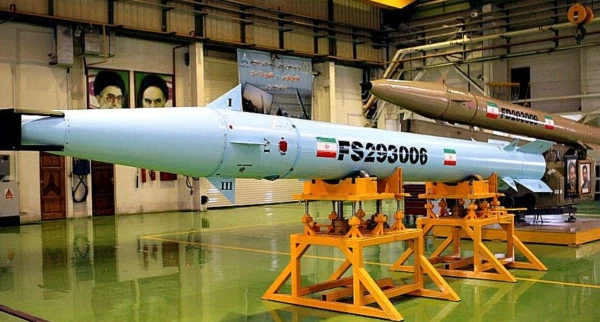
The Iranians plan to strike targets in the Jewish state with ballistic missiles.
After the twelve-day war last summer, when Israel struck hundreds of targets in Iran related to military infrastructure, the nuclear and defense industries, and neutralized most of the country's air defense systems, Tehran is preparing for a new war for the survival of the regime. But while Russia, a long-time ally of Iran, hesitates and delays the promised deliveries of Su-35s and modern air defense systems, China is stepping up and becoming the leading supplier to the Iranian army.
For many years, Iran has focused on developing its own military technologies, minimizing imports. This was partly due to difficulties in procuring foreign weapons, but also due to a desire to increase autonomy.
Two Generations Behind
For example, in air defense, Iran has modernized numerous American missile systems and even established production of certain Russian models. The Air Force relied on limited purchases from Russia and China, as well as on the modernization of old American aircraft with Chinese onboard electronics.
But by the end of 2025, it became clear that this approach had not been justified. The Islamic Revolutionary Guard Corps (IRGC) and the armed forces of Iran have always shied away from questions about the capabilities of Iranian surface-to-air missile systems and even embellished the capabilities of one of their newest developments — Bavar 373.
One high-ranking IRGC officer recently admitted that all Iranian air defense systems demonstrated low effectiveness during the Twelve-Day War, even falling short of outdated Russian systems. As for the Air Force, Iran's attempts to develop light fighters have led to nothing. The aircraft developed during the modernization program of American planes from the 1970s could only flee when encountering Israeli fighters. As of June 2025, Iran lagged behind Israel and the United States by almost two generations.
Slowly from Russia
As Iran's attempts to develop its own technologies failed, there arose an acute need for military equipment procurement. In October, the Kremlin hinted that the supply of Russian weapons to Iran was a consequence of the Twelve-Day War. However, two weeks earlier, a leaked document was published indicating that Russia and Iran had agreed on the sale of 48 Su-35 fighters back in 2022.
The purchase of Su-35s had been announced by Iranian authorities for years — there is nothing new in this regard. But for the first time, the exact volume of the deal was mentioned. Deliveries were supposed to have already begun, and Iranian defense structures are loudly complaining about delays, which they attribute to Russia's desire to maintain relations with Israel. According to sources in the Iranian armed forces, the execution of the contract began back in 2022. At that time, Iranian pilots and technicians started training in Russia to prepare for the arrival of the new aircraft.
Iranian defense structures are loudly complaining about delays, which they attribute to Russia's desire to maintain relations with Israel.
In addition, Iran has begun receiving modern training-combat aircraft Yak-130 from Russia, which is also related to the procurement of Su-35s. However, the new combat aircraft have not yet arrived.
Now, according to the same Iranian sources, the Russian government has finally agreed to start deliveries of Su-35s. Initially, 24 Su-35S fighters (part of an order canceled by Egypt) will be transferred to Iran, and another 24 new production fighters will arrive in 2026–2027. Russia has indirectly acknowledged its guilt for the delay by gifting Iran, according to sources in Tehran, half a dozen upgraded MiG-29 fighters.
However, the October delivery of such a small number of these fighters does little to change the balance of power between Iran and Israel, let alone the United States. From Russia's perspective, this is a gesture of goodwill towards Iran and a kind of assurance that this time it is serious. It may also serve as a reminder that Russia could also quickly and cheaply upgrade a small Iranian squadron of MiG-29s to 4++ generation standards.
Realistically speaking, Iran will not be able to fully replace its outdated fleet of aircraft in the near future, neither due to cost nor production timelines. Therefore, it may only be a matter of partial modernization of the fleet. Today, Russian pilots primarily use MiG-29s for advanced training, so this could be another reason for the delivery — to prepare Iranian pilots for the Su-35 as quickly as possible.
Iranians would also like to acquire the S-400 air defense system — the most modern option available to them. Russian leadership denies that Iran approached them regarding the S-400 before the Twelve-Day War, but now this issue is definitely on the agenda — due to its long range and ability to hit F-35s, albeit at a shorter distance. Sources in the IRGC report that one battery has already been delivered and is active in Isfahan, where one of Iran's most important nuclear facilities is located.
One S-400 battery is already active in Isfahan, where one of Iran's most important nuclear facilities is located.
Larger deliveries have not yet been agreed upon, but they are not ruled out either. Although Russia clearly needs S-400s to protect its own airspace, since the invasion of Ukraine, it has sharply increased the production of these systems, so theoretically, it could share them with Iran. Nevertheless, the Iranians are extremely concerned about the slow pace of negotiations.
Beijing Takes the Lead
Previously, Russia was the main supplier of modern weapons to Iran, while China held second place, but with a significant gap. However, in recent years, Iran has increasingly begun to import military technologies from China — particularly for the modernization of air defense systems and combat aircraft. Due to the Kremlin's hesitations, China seems to be becoming the leading supplier of defense products for the Iranian army, as it is more open to negotiations and less constrained by its own needs.
China is becoming the leading supplier of defense products for Iran — it is more open to negotiations and not constrained by its own needs.
Sources in the IRGC report that in July, Iran signed a contract with China for the supply of HQ-9 air defense systems. This likely refers to version B — essentially an improved derivative of the Russian S-300 system. The order is small, around six batteries with six launchers each. But the deal looks much more attractive than the supply of four Russian S-300 batteries stretched over nine years. In terms of delivery timelines, China has virtually no equal, and by October, half of the batteries had reached the recipient.
According to the same sources in the IRGC, China has already sent consultants and technicians to Iran to assist with the deployment of HQ-9 and train the crews, as well as to prepare the ground for future deliveries of J-10C fighters. Based on this, the agreement for the sale of J-10C has either already been signed or is in the final stages. And although the range of the J-10C is less than that of the Su-35, in some respects, the light fighter is more modern, especially in terms of radar.
Focus on Ballistics
Iranian military officials are confident that a new war is not far off. They view it as an existential threat to the regime and are rushing to fill the most obvious gaps in defense. So far, according to sources in the Iranian armed forces, the integration of the delivered HQ-9 batteries into the national air defense system has not even begun. This is despite the fact that one of the main conclusions of the Twelve-Day War is that the Iranian air defense system, equipped with a vast number of systems of Russian, Chinese, American, and local origin, often using completely different technologies, suffers from integration issues.
The full implementation of new systems may take a long time, or it may not happen at all. The supply of new systems will only exacerbate the situation, as the integration of new models will take years. Therefore, the Iranians seem to have abandoned the idea of creating a fully-fledged national air defense system in the near future. Instead, they aim to increase the "cost" of penetrating their airspace for the Israelis. Rather than using HQ-9 to improve the entire system, the Iranians apparently intend to use them to protect particularly important facilities.
The Iranians seem to have abandoned the idea of creating a fully-fledged national air defense system in the near future.
The Russian radar "Resonance," which Iran has in its arsenal (under the name Ghadir), according to Iranian military sources, is indeed capable of detecting Israeli stealth aircraft. However, Iran has not had any system capable of hitting F-35 fighters. Now, this task can be partially handled by the single S-400 battery and possibly the HQ-9 systems — if it is indeed version B.
Although such capabilities are still limited, they will increase the risks of a potential new air campaign for Israel. But this is contingent on the Iranians managing to protect the new system from special forces raids next time.








Leave a comment