
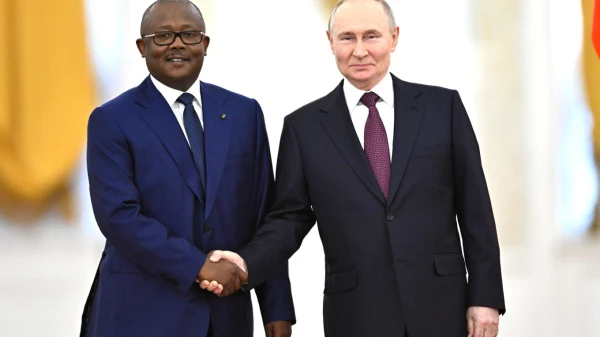
The military arrested all the leadership of the underdeveloped country.
The military of Guinea-Bissau, with a population of over 2 million people, announced a transfer of power in the country under their control, reports Africaguinee. President Umaro Sissoco Embaló confirmed the fact of a coup d'état and stated that he is under arrest at the General Staff headquarters.
Umaro Sissoco Embaló has visited Russia four times and met with Vladimir Putin. In October 2022, he arrived in Moscow as the acting chairman of the Economic Community of West African States (ECOWAS). In July 2023, he led the Guinea-Bissau delegation at the "Russia-Africa" summit in St. Petersburg, where he held talks with Putin on economic cooperation between the two countries.
In May 2024, he met with Putin again, participating in events marking Victory Day. Embaló also visited Chechnya, where an agreement was reached for the training of Guinea-Bissau's military at the Russian Special Forces University. His last visit to Russia took place in February 2025.
Alongside Umaro Sissoco Embaló, under arrest are the Chief of the General Staff of the Armed Forces, General Biague Na Ntan, his deputy, General Mamadu Ture, and the Minister of Internal Affairs, Boche Kande.
The military explained their actions as a collusion between the country's leadership and drug barons. To "restore constitutional order," they introduced six urgent measures, which include the removal of Umaro Sissoco Embaló from the presidency, the suspension of elections in the country, and the closure of all institutions until further notice.
The list of measures also included the suspension of media operations, the closure of land, sea, and air borders, and the introduction of a curfew from 21:00 to 06:00. In their address, the military called on citizens to remain calm, cooperate, and understand the emergency situation in the country.
On November 23, presidential elections were held in Guinea-Bissau. Umaro Sissoco Embaló declared victory, reporting that he received 65% of the votes, while the opposition candidate, Fernando Dias de Corta, also declared himself the winner. Official election results were to be published on November 27.
Guinea-Bissau is a country in West Africa, a former Portuguese colony, and has been an independent state since September 24, 1973. In addition to the mainland, it includes Bolama Island and the Bijagos archipelago. It borders Senegal to the north and Guinea to the southeast.
Guinea-Bissau was part of the Kaabu kingdom and also part of the Mali Empire. Some of its territories existed within their composition until the 18th century, while others were under the control of the Portuguese Empire since the 16th century. In the 19th century, they became part of Portuguese Guinea. Guinea-Bissau has a history of political instability since gaining independence.
For 2% of the population, Portuguese is the native language, and for 33%, it is the second language. Guinean Creole is also widely spoken. According to a 2012 study, 54% of the population speaks it as their native language, and about 40% as a second language. The rest speak various indigenous African languages. The main religions are Christianity and Islam. The gross domestic product per capita in the country is one of the lowest in the world.



Leave a comment