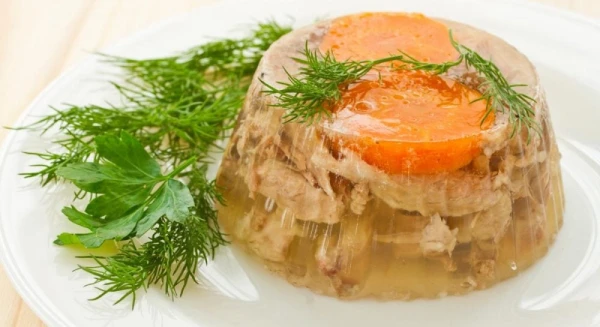
Aspic, jelly, cold meat… Some recall the phrase from the movie “The Irony of Fate, or Enjoy Your Bath”: “What a nuisance this aspic fish is!” Others eagerly await the New Year’s feast. We decided to clarify with a nutritionist what role this dish plays in maintaining youthful skin.
Expert - Elena Manokhina, nutritionist.
The history of aspic dates back hundreds of years. Even then, it was valued for its benefits and convenience: shepherds, warriors, hunters, and travelers took it with them. Aspic is also mentioned in the “Domostroy” as a beneficial dish for joint and bone system diseases.
The nutritional value of aspic depends on its composition (meat, fish, using gelatin or not, with vegetables and other ingredients). Thus, the calorie content can range from 50 kcal (for example, from lean fish) to 350 kcal (from pork) per 100 grams. Meat aspic contains a sufficient amount of vitamin A, B vitamins, magnesium, sodium, iron, and other nutrients. Fish aspic can boast the presence of polyunsaturated fatty acids (omega-3), phosphorus, zinc, and other beneficial substances.
Despite many positive properties, there are contraindications to consuming aspic: for people with exacerbations of certain gastrointestinal diseases and some urinary system diseases.
Considering modern trends towards a healthy lifestyle, including nutrition, aspic is interesting for its composition, namely the presence of collagen. Scientists have described more than 25 types of collagen. Depending on the type, collagen exhibits certain properties. For example, collagen types I, V, VI, and VIII are found in bones; collagen type V is found in hair; and types I, III, V, VI, and VIII are found in skin.
There is information that the word “collagen” is translated from Greek as: “kolla” — glue, “genes” — producing. This translation well describes the property of collagen.
It seems simple: eat aspic — get collagen, improve your ligaments, joints, skin… But collagen, like all proteins, when ingested, is broken down in the gastrointestinal tract into peptides and amino acids. Then the body uses the components of the protein, including collagen, for its own needs: for building cells, producing antibodies, hormones (for example, tyrosine is part of thyroxine, adrenaline…), enzymes, blood cells, and so on. Proteins are also used as an energy substrate.
To produce its own collagen, the body needs many additional nutrients besides amino acids: vitamins C, B, iron, copper… The formation of collagen in the body from incoming nutrients is a complex process consisting of several stages, starting with the assembly of the chain inside the cell, then continuing in the intercellular substance.
Collagen is used not only in the food industry but also in medicine: in the creation of skin substitutes, medications, and in dermatology.
Following the golden rule of a healthy lifestyle — everything should be in moderation: aspic can be consumed as a variety in the diet and a source of beneficial nutrients in moderation, considering the daily energy and nutrient needs of the body.