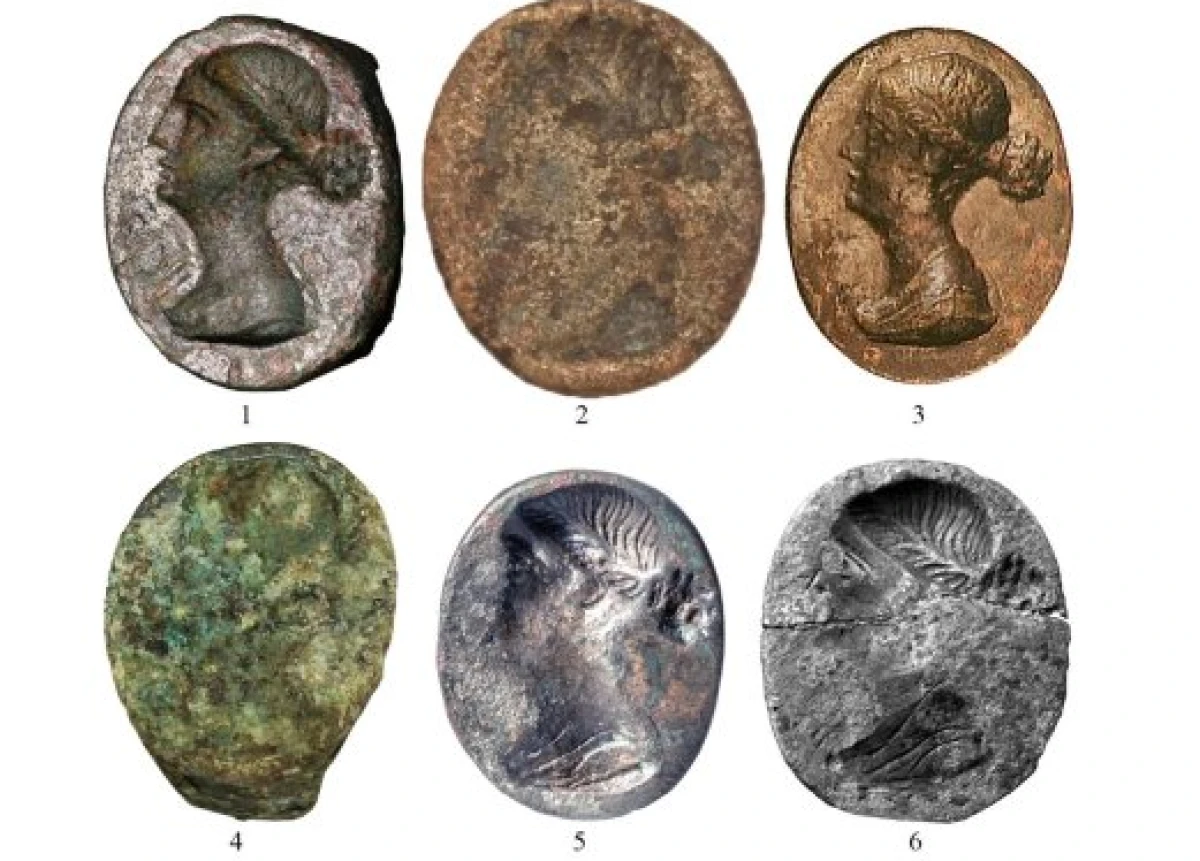
With the new find, there are six such rings.
During excavations of the estate group "Voskresenskoe 6" on the outskirts of modern Anapa, archaeologists discovered a bronze ring featuring the portrait of Arsinoe III. This Egyptian queen from the Ptolemaic dynasty ruled around 220–204 BC.
In ancient times, the territory of present-day Anapa was home to Gorgippia – one of the cities of the Bosporan Kingdom, the largest Greco-Barbarian state on the northern shore of the Black Sea. The estate group "Voskresenskoe 6" was likely part of the chora – a rural district – of Gorgippia. The ring was found in a utility pit, which also contained fragments of ceramic vessels from the 4th–3rd centuries BC.
The find is massive, with an oval bezel made of lead-tin bronze. The image of the queen is carved on the bezel, showing only her head, neck, and part of her shoulder. Her head is turned to the left, and folds of the edge of a chiton – traditional Greek clothing – are visible on her neck. The artist depicted her hairstyle with vertical, slightly bending narrow rolls. Another roll frames her hair, transitioning into a large bun with rounded protrusions at the back of her head. These protrusions could represent either curled locks, or the heads of hairpins, or a wrapping of threads with beads.
The assumption that the portrait belongs to Arsinoe III can be made based on analogies, including images on coins. The authors of the article highlight rings where the queen is depicted with a bun of hair with rounded protrusions as a separate group. With the new find, there are six such rings. Three of them come from the Bosporus, including another one from the vicinity of Gorgippia, and one from Panticapaeum, the capital of the kingdom. The other three rings come from the Meotian burial mounds of the Kuban region.
In the Northern Black Sea region, several dozen bronze rings depicting queens and kings from the Ptolemaic dynasty are known. There is no consensus on how these ornaments ended up on the northern shore of the Black Sea and why such finds are concentrated there. Some researchers believe that the rings were brought by Bosporan mercenaries serving the Egyptian kings. Others suggest that the appearance of "Ptolemaic-type" rings is related to the spread of Egyptian cults. A third group believes that these were prestigious gifts to the Bosporans involved in grain export. A fourth group thinks they reflect diplomatic contacts between Egypt and the Bosporus.
Evidence of diplomatic ties exists in other sources as well. A graffiti depicting an Egyptian ship from a sanctuary in Nymphaeum dates back to the mid-3rd century BC. There is also written evidence of a visit by the Bosporan king Perisades II to Egypt around the time close to the appearance of the graffiti.