
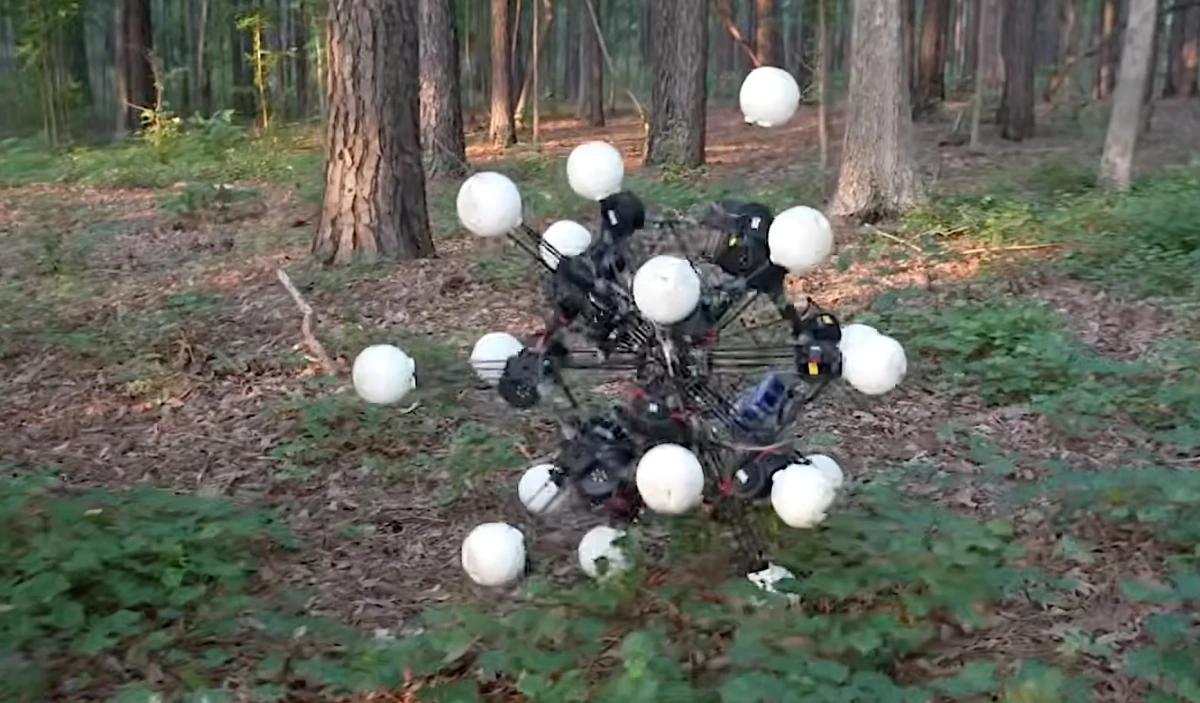
American engineers have developed an unusual robot inspired by descriptions of biblical ofanim—creatures covered in eyes. The machine is not only capable of seeing 360 degrees but also confidently moves across sand, forest trails, and even between vertical walls.
Researchers from Duke University have introduced an unusual robot named Argus, which has already attracted the attention of both specialists and internet users. The reason is its appearance. The robot resembles descriptions of ofanim from biblical texts, which are often depicted as wheels covered with numerous eyes.
Argus is a spherical structure with a central core and twenty telescopic legs arranged in a circle. At the ends of these legs are cameras and depth sensors, allowing the robot to observe its surroundings in almost all directions simultaneously.
The project's creator, Professor Boyuan Chen from Duke University's engineering department, explained that the team deliberately rejected popular humanoid or animal forms. According to him, the goal was to create a fundamentally new structure.
"We are not imitating anything specific in nature; we are imitating everything in it," Chen clarified.
Each of the twenty legs can extend and retract independently, enabling the robot to adapt to surfaces and overcome obstacles.
During tests, Argus successfully moved across asphalt, sand, and rugged forest terrain. Particularly impressive was an experiment in which the robot ascended between two parallel walls, sequentially pushing off from them and moving upward.
To assess the effectiveness of the design, researchers developed a new metric called "dynamic isotropy." This measures how uniformly the robot can accelerate while moving in different directions. Most existing robots and drones score less than 0.6 on this scale. Argus achieved a score of 0.91, indicating high maneuverability and the ability to quickly change direction without losing stability.
The developers believe that such designs could be applied in areas where traditional robots struggle: in surveying complex terrain, search and rescue operations, or exploring hard-to-reach objects.
Currently, Argus remains a research project, but it already demonstrates how unusual next-generation robots can be when engineers stop copying humans and animals.















Leave a comment