
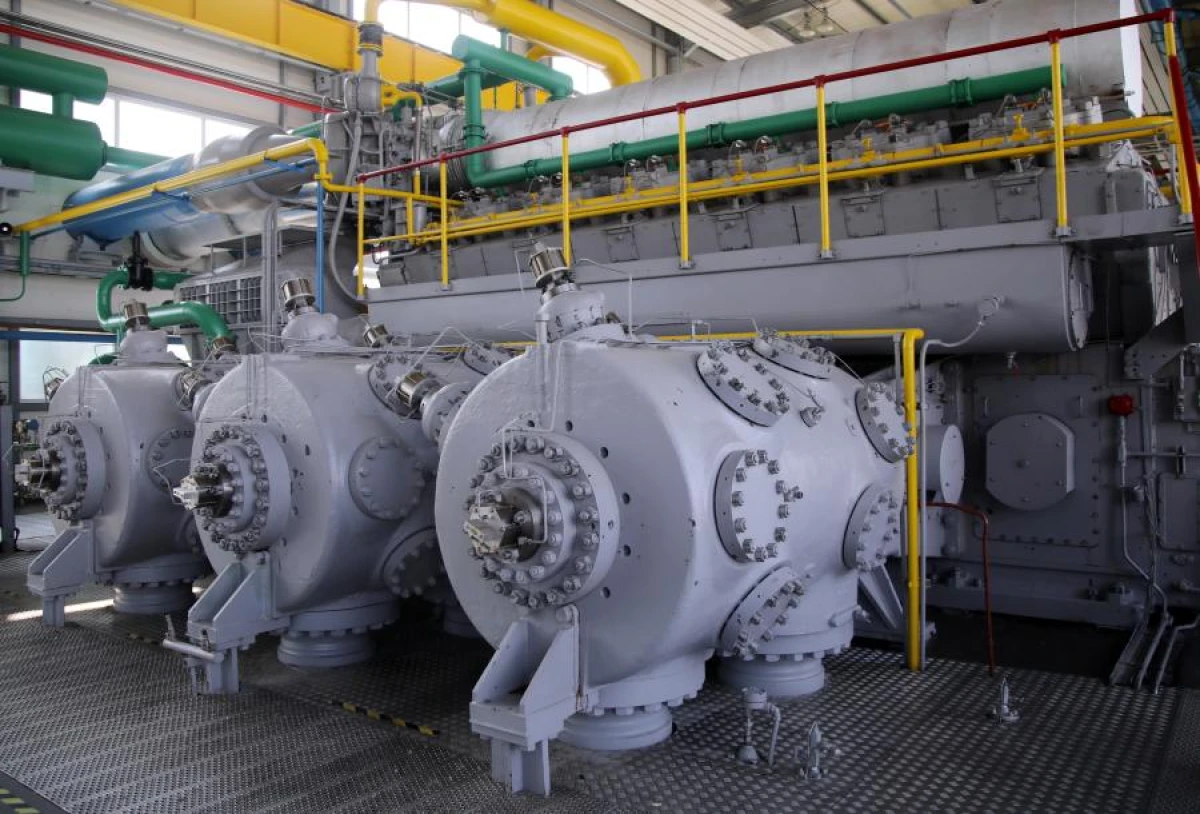
Total natural gas consumption in Latvia during the past heating season from November 2025 to April 2026 was 26% higher than in the corresponding period a year earlier, representatives of the Public Utilities Commission (PUC) reported to LETA, citing a natural gas market review.
The Public Utilities Commission (PUC) explains that the increase in consumption was influenced by record low air temperatures in January and February.
In April, the average monthly price on the TTF (Title Transfer Facility) natural gas exchange reached €45.56 per megawatt-hour (MWh). The rise in natural gas prices in the first quarter of this year was mainly driven by the escalation of the conflict in the Middle East and growing concerns about shipping restrictions in the Strait of Hormuz.
The price of natural gas on the global wholesale market (exchange), or the import price of natural gas, affects the final price at which it is sold. Price indices from European exchanges are typically used as benchmarks for natural gas prices when contracts for its import to Latvia are concluded. This pricing mechanism for natural gas is also common for retail market supplies, for example, when purchasing natural gas from a trader in Latvia for heat production or for operating manufacturing equipment.
The average weighted retail price calculated by the PUC, which reflects the average level of natural gas prices in Latvia, decreased to €47.78 per MWh in the household segment and to €40.54 per MWh in the business segment in the first quarter of 2026. Compared to the first quarter of 2025, prices were respectively 1% higher in the household segment and 7.8% lower in the business segment.
The price of natural gas is one of five components that make up the total payment for natural gas by the user. The price depends on the offer of the chosen trader, while the tariffs for the other included services of distribution and transmission are set by the PUC, and the value-added tax and excise tax are set by the state.
Currently, there are 13 active natural gas traders for businesses in the retail market of Latvia, of which five also provide services to households: JSC "Latvijas gāze", JSC "Latvenergo", LLC "Elenger", LLC "Alexela", and LLC "MVBK".
The activity of changing natural gas traders in the household segment in the first quarter of 2026 reached 0.8%, which is a higher figure than in the corresponding period of 2025 (0.7%). In turn, in the business segment, activity decreased to 2.3% compared to 2.7% a year earlier.
In Latvia, natural gas is stored in the Inčukalns underground gas storage facility, managed by JSC "Conexus Baltic Grid". As of the end of April 2026, the filling level of the Inčukalns underground gas storage facility was 26%, corresponding to 6.4 terawatt-hours (TWh). The volume of natural gas reserves this year was lower compared to the same date last year. The PUC explains that this trend is not unique to Latvia. According to data collected on the transparency platform "Aggregated Gas Storage Inventory" (AGSI+) by the Gas Infrastructure Europe (GIE) association, the average filling level of gas storage facilities in Europe at the end of April was approximately 32%. There is also a decrease at the European level compared to the same date last year.











Leave a comment