
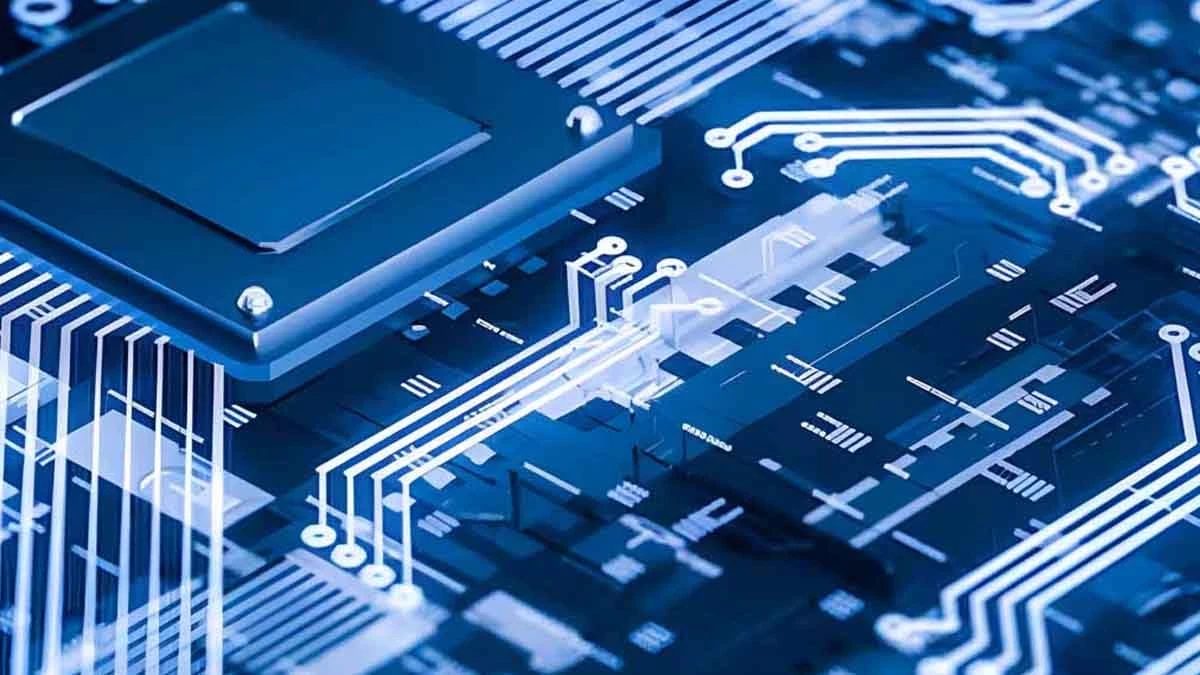
It has achieved a record integration density.
Huawei, in collaboration with Chinese researchers, has developed the world's first chip for two-dimensional parallel computing. As the shortcomings of Moore's Law begin to manifest at the forefront of technology, Chinese scientists are seeking improved alternatives capable of addressing the challenges arising in chip manufacturing.
One such approach is the two-dimensional parallel computing chip. Two-dimensional components, such as molybdenum disulfide, are thin and allow electrons to move stably throughout the process, making them robust enough to circumvent Moore's Law.
This 2D chip is called Mengqi-1000 or Magic 1000. It has achieved a record integration density. This new invention proves that China can make significant advancements without relying on American technologies.
Magic-1000 uses the RISC protocol designed for high-efficiency command processing. Additionally, it integrates a complete set of core modules, such as an instruction decoder, a register file, and an ALU.
The Magic-1000 technology consists of transistors based on molybdenum disulfide, arranged on a tiny area, with a density of 9336 transistors per square millimeter — surpassing previous records and comparable to silicon chips of the same technology process.
Moreover, it supports parallel multi-bit data input and output, operating at a frequency of 43 kHz. The new computing chip allows for the avoidance of delays associated with external memory, thanks to the register file applied directly to the chipset.
Technologies such as multi-level joint optimization methods and hybrid approaches have aided in the creation of the 2D parallel chip. They ensured the uniformity of transistors already at the material selection stage. Instead of a two-row layout, a three-row layout is used, which balances the margin of noise immunity and area.
Previously, researchers from Peking University announced that the 3D design tools they developed are the foundation of Huawei's innovative chip development – a new "Logic Folding" architecture.
He Tingbo, head of Huawei's scientific group and president of its semiconductor business, believes that the new Tau scaling law sets a new direction for the global chip industry and will soon be implemented in chip technologies at an international level.















Leave a comment