
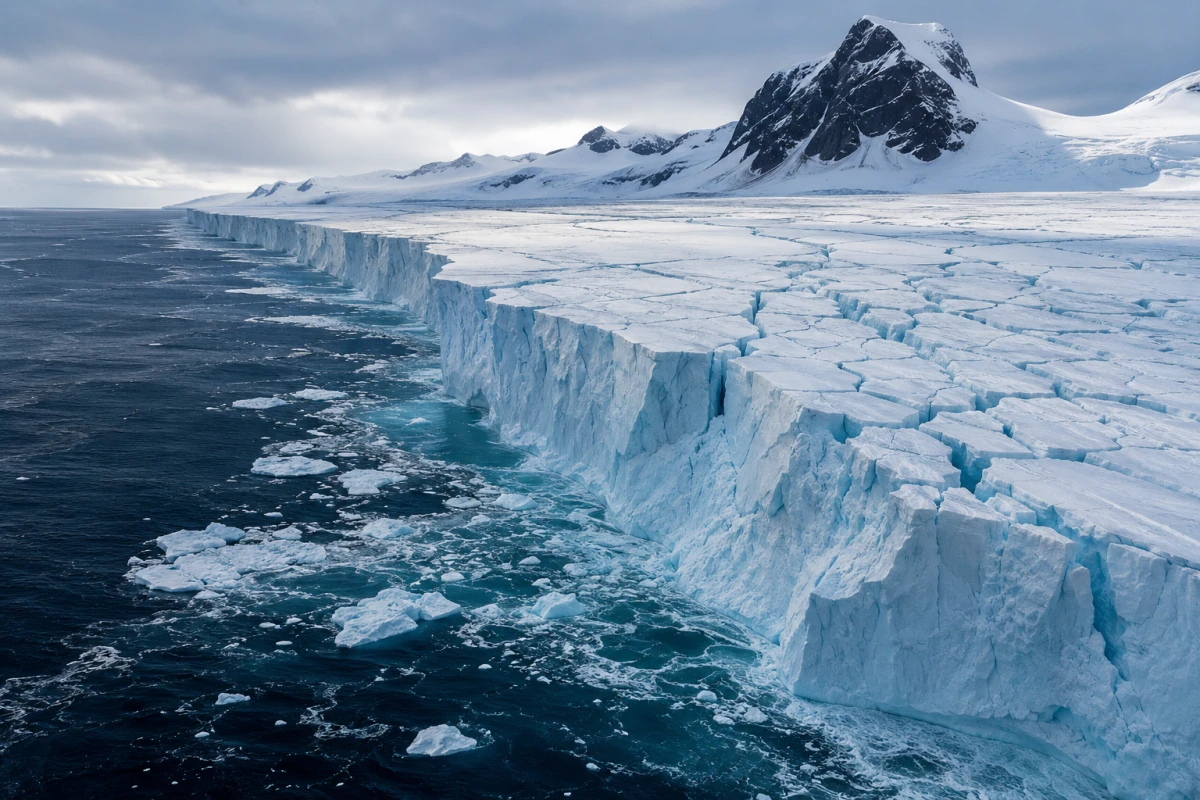
The Antarctic Thwaites Glacier, which scientists refer to as the 'Doomsday Glacier,' continues to rapidly lose stability. Researchers are recording an acceleration in ice movement, an increase in cracks, and the destruction of the shelf holding vast amounts of frozen water. Experts estimate that a critical moment could occur as early as 2067.
What is Happening with the 'Doomsday Glacier'
Thwaites Glacier is the widest glacier on Earth, with a width of about 120 km and a basin area of 192,000 sq. km (which is larger than Florida and the combined area of England, Wales, and Northern Ireland). It is located on the coast of the Amundsen Sea, near Mount Murphy.
Scientists have long considered this glacier potentially dangerous; it is vulnerable to environmental changes and serves as a barrier, holding back the movement of vast amounts of ice into the ocean.
The eastern floating ice shelf of the glacier (the size of Greater London) has begun to collapse rapidly — due to cracks, it resembles a shattered windshield.
From January 2020 to January 2026, the speed of ice movement on the shelf has increased more than threefold — to 2,000 meters per year.
The speed of the ice itself, which the shelf holds back, has increased by 33%.
The destruction is occurring from multiple sides; from below, the shelf is melting due to changes in ocean circulation, while the load on the stable parts of the shelf is increasing due to the acceleration of ice movement.
According to Rob Larter, a researcher at the British Antarctic Survey, it is similar to predicting an earthquake; scientists see the growing tension but cannot pinpoint the exact moment.
Forecast
A group of researchers from the University of Edinburgh, using satellite data, has made a forecast: a critical situation could arise in 40 years — by 2067. At that time, the glacier could begin to lose 180–200 gigatons of ice annually. Currently, Thwaites accounts for about 4% of global sea level rise, but in the coming decades, this figure could sharply increase.
Possible Consequences
-
a rise in global ocean levels by 3.4 meters (although some scientists consider this figure exaggerated);
-
flooding of areas where millions of people live;
-
disappearance of island nations (such as the Maldives and Tuvalu);
-
a threat to major cities: New York, Shanghai, London, Rotterdam, and others.
The accelerating collapse of Thwaites Glacier is becoming one of the most alarming climate signals in recent years. Although the exact timing of a possible collapse is still unknown, scientists warn that changes in Antarctica are already capable of affecting the future of the world's oceans and the lives of millions of people around the globe.













Leave a comment