
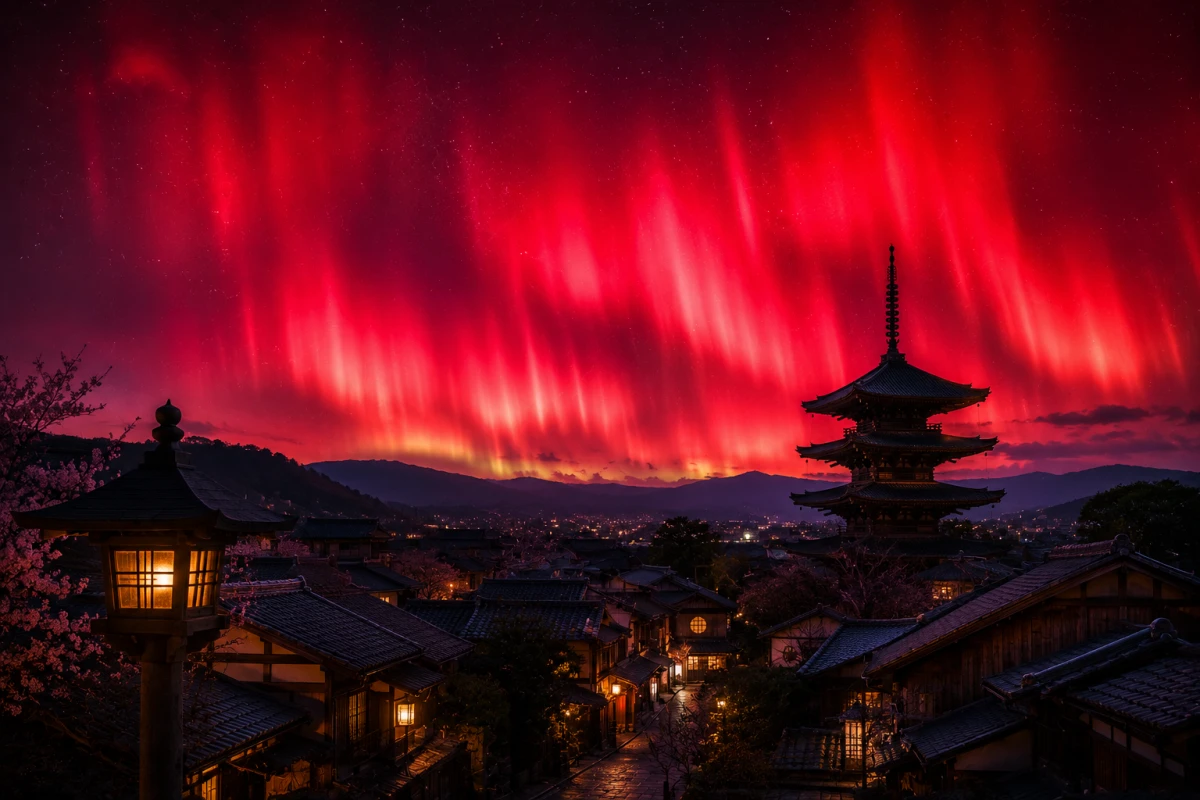
Scientists have found evidence of a powerful solar storm that occurred over 800 years ago. Traces of the cosmic event have been preserved not only in the annual rings of trees but also in medieval records of an unusual red glow over Japan.
Researchers from Japan have managed to reconstruct the picture of an ancient solar storm from the early 13th century by combining data from tree rings and historical chronicles. This concerns a powerful solar proton event — an ejection of high-energy particles from the Sun that can affect the Earth's atmosphere and modern electronics.
The key to the discovery was the diary of the Japanese poet and courtier Fujiwara no Teika, who lived in the 12th–13th centuries. In February 1204, he described an unusual phenomenon — "red lights in the northern sky over Kyoto." For the inhabitants of Japan at that time, this appeared mysterious: Kyoto is too far from the polar latitudes where the northern lights are usually observed.
Today, scientists believe that the poet witnessed an extremely powerful aurora borealis caused by intense solar activity.
Additional confirmations were found in Chinese astronomical records from that period, which also mention an unusual red glow in the sky.
However, the main evidence came from the trees.
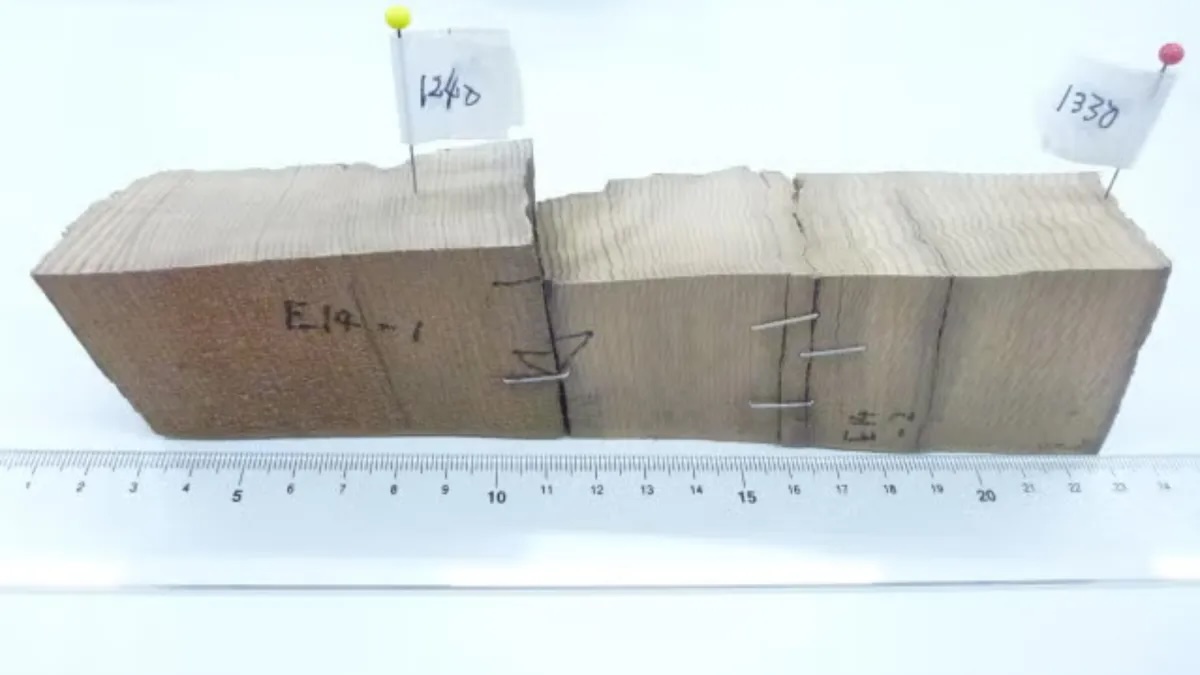
A team of researchers led by Hiroko Miyahara from the Okinawa Institute of Science and Technology discovered elevated levels of carbon-14 in ancient tree rings — an isotope that forms when high-energy particles collide with the Earth's atmosphere.
Traces were found in the remains of asunaro trees that are about 825 years old. Analysis showed that between the winter of 1200 and the spring of 1201, the Earth experienced a so-called "sub-extreme" solar proton event.
Such events are weaker than the most destructive solar storms but can still pose a serious threat — especially to satellites, spacecraft, and astronauts.
According to Miyahara, previous research has mainly focused on rare super-powerful solar storms, and now scientists have gained a tool to study less extreme but more frequent events.
The discovery also led to another unexpected conclusion: in the early 13th century, solar cycles were significantly shorter than today’s. While today the Sun's activity typically changes approximately every 11 years, back then the cycle lasted only seven to eight years. This indicates an extraordinarily active Sun during that period.
Researchers were particularly surprised that a strong aurora occurred almost at the time of the solar cycle minimum — contrary to modern understandings of space weather.
"This is unexpected, and we are very interested in studying in more detail what solar conditions could have caused such a phenomenon," noted Miyahara.
It was previously believed that the peak of solar activity over the last thousand years occurred around the period after 1940. However, the new study suggests that the Sun may have been even more active in the medieval period.
The work of Japanese scientists shows that the history of the Sun can be studied not only through telescopes and satellites but also through old trees, ice cores, and even the diaries of people who lived hundreds of years ago.












Leave a comment