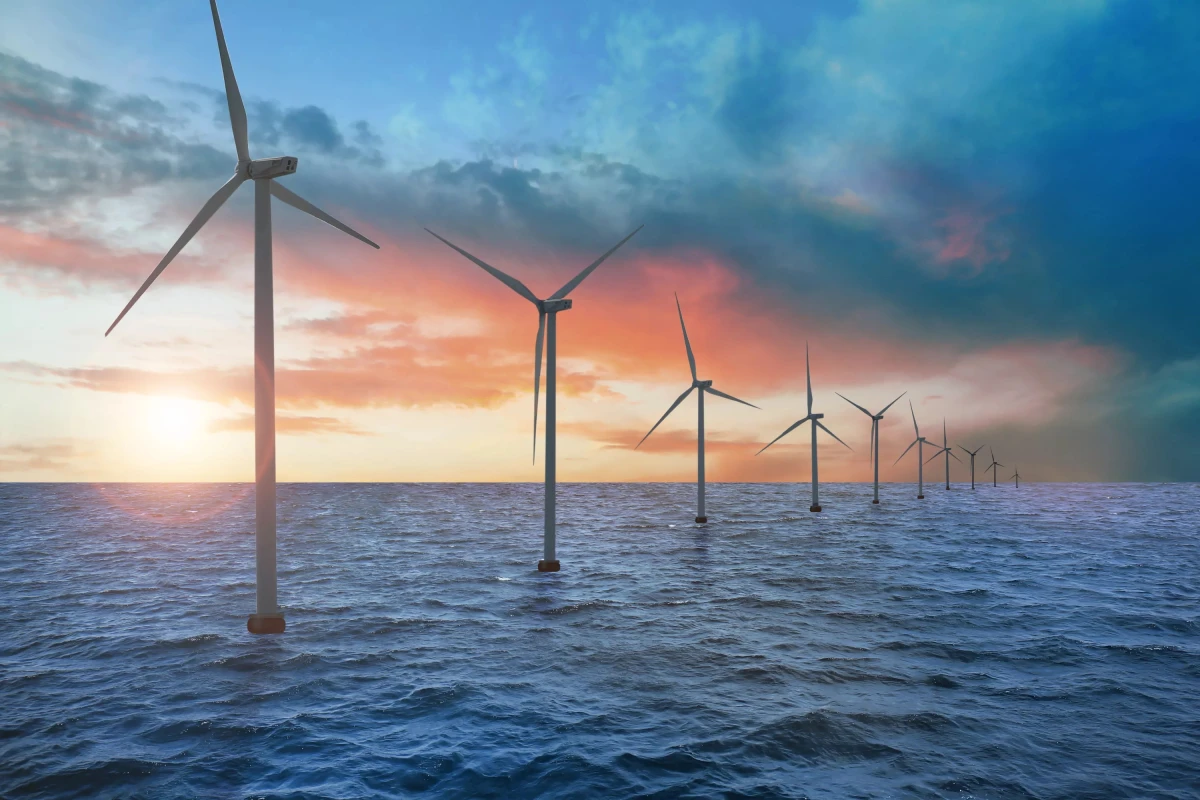
Construction has begun in the North Sea on Thor, the largest offshore wind farm in Denmark's history. Once operational in 2027, it will be able to supply electricity to about a million European households and will become one of the most powerful marine energy projects in Europe.
Denmark has begun construction of the largest offshore wind farm in its history. The project, named Thor, will be located in the North Sea and, once operational, will be able to supply electricity to about a million European homes, reports bb.lv, citing the publication Ecoportal.
The scale of the project is impressive: the area of the wind farm will be larger than the American city of Cleveland. Construction is taking place approximately 22 kilometers off the west coast of Denmark, near Tursminde.
The project is being implemented by the German energy company RWE in collaboration with Norges Bank Investment Management. The wind farm is expected to be fully operational by 2027.
The site will feature 70 giant Siemens Gamesa SG 14-236 DD turbines, each with a capacity of about 15 megawatts. The height of the structures, including the blades, will reach approximately 266 meters.
The size of the blades is particularly impressive – their length is about 115 meters, which exceeds the length of a standard football field.
The total capacity of Thor will exceed 1000 megawatts. This is enough to supply electricity to approximately one million households.
Why the North Sea is ideal for such projects
The North Sea is considered one of the best regions in Europe for offshore wind energy due to its stable and strong winds. Unlike onshore power plants, offshore turbines can generate more energy almost year-round.
However, construction in such conditions is associated with serious technical challenges.
Engineers have to take into account storms, corrosion from saltwater, strong currents, and constant loads on the structures. To install the turbines, massive foundations are driven into the seabed at a depth of about 28 meters.
The main problem – transmitting energy to shore
One of the most challenging tasks of the project has been organizing the transmission of electricity to land.
Energy from the turbines will be transmitted via underwater cables to offshore substations, where the current is stabilized and distributed. After that, electricity will be sent to Denmark's energy system through export cables laid on the seabed.
Due to the remoteness of the site, servicing the turbines will also be challenging – specialists will have to reach them by boats or helicopters.
Europe bets on offshore energy
The Thor project is part of a broader strategy by Denmark and EU countries to phase out fossil fuels and develop renewable energy.
In recent years, Northern European countries have been actively transforming the waters of the North Sea into a huge energy cluster with offshore wind farms.
Once construction is completed, Thor will become one of the largest offshore wind farms in Europe.
The energy situation in Europe
In France, on May 21, there was a sharp increase in solar energy production. Sunny weather contributed to an increase in electricity generation, allowing for a significant boost in electricity exports to neighboring markets, reports Bloomberg. In the next two days, electricity generation is expected to increase even more.
The average modern nuclear reactor generates about 900 megawatts of electricity. The efficiency of nuclear energy reaches approximately 93%, meaning the reactor operates at full capacity almost constantly.
In the editorial's opinion, the Thor project reflects the course of European countries towards the accelerated development of renewable energy and reducing dependence on fossil fuels. Despite the complexity of constructing and servicing offshore wind farms, the North Sea is gradually becoming one of Europe's key energy centers.