
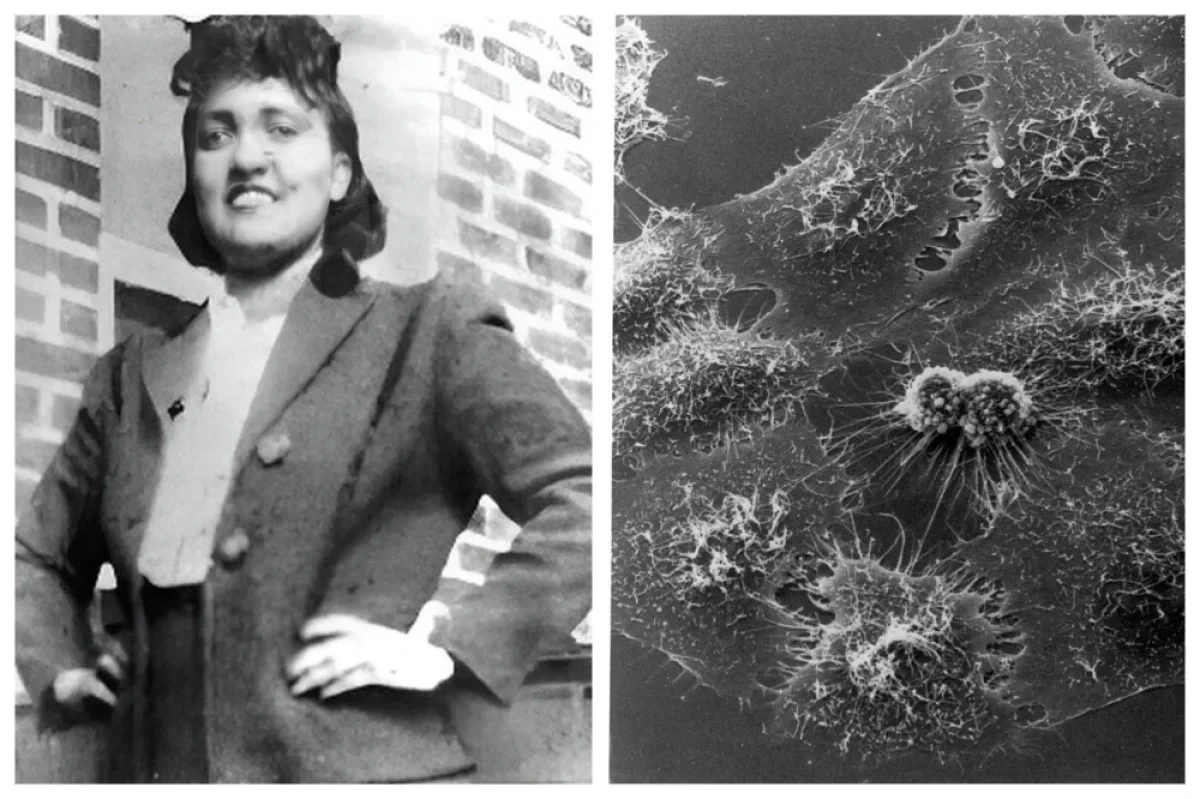
Not everyone knows that there are "immortal" cells that have outlived the person who gave birth to them by several decades and continue to live and divide in laboratories around the world. Their total biomass has far exceeded the body mass of their host — American Henrietta Lacks, who died in 1951.
Thanks to these cells, a vaccine for polio was created. They were sent into space, and drugs for cancer and AIDS were tested on them. Biologically, the HeLa cells (as they are called) have long become a separate species, and scientists are discussing whether to include it in the official classification of organisms.
We tell the amazing story of how an unremarkable housewife gave rise to a new form of life. And in a sense, she became the first immortal person on Earth.
And Science Did Not Ask
In early 1951, 31-year-old African American Henrietta Lacks from Virginia, a mother of five, went to Johns Hopkins Hospital complaining of lower abdominal pain. This clinic was one of the few medical institutions that accepted black patients from poor neighborhoods.
The diagnosis was ruthless: aggressive cervical cancer. During the examination, the doctor removed samples of Henrietta's tumor tissue and, in accordance with the practices of that time, did not inform her of the further fate of the biological material. That is, he did not ask for her consent to use the tissues removed from her body in any way. At that time, this was not required.
Henrietta Lacks's biological samples ended up in the laboratory of Dr. George Gey. He had been searching for a way to grow human cells outside the body, in a Petri dish, for several years, but all these attempts ended in failure. The cells aged and died within a few days.
But Henrietta's cells behaved differently. They not only survived — they began to divide at an astonishing rate, doubling their population every 24 hours. Thus, the HeLa cell line was born — the first human cells in medical history that never die. They do not need a host organism; they only need a nutrient medium and space to live.
The term HeLa is an acronym, a word formed from the first letters of Henrietta Lacks's name. The patient herself died on October 4, 1951, eight months after the diagnosis.
She never learned that her cells gave rise to a new era in medical science.
Why Do Her Cells Not Die?
Normal human cells are programmed for aging and death. At the ends of chromosomes are protective "caps" — telomeres. With each division, they shorten, and after 50-56 cycles, a human cell stops reproducing and dies — this is called the Hayflick limit.
Apparently, a systemic failure occurred in Henrietta Lacks's cancer cells. A mutation activated the enzyme telomerase, which rebuilds telomeres after each division, preventing chromosomes from wearing out. Thus, the aging mechanism of the cells was turned off. They are capable of dividing indefinitely, which is exactly what happens. The total biomass of all HeLa cells grown in laboratories around the world has already exceeded the body mass of Henrietta herself during her lifetime by several times.
Research on the HeLa cell culture helped scientists understand the mechanism of telomerase, for which the Nobel Prize in Physiology or Medicine was awarded in 2009. In general, the number of scientific publications referencing the use of these cells has exceeded 110,000. It is difficult to find a field of biomedicine where HeLa has not been involved. Here are just a few key studies.
In the 1950s, a victory over polio was achieved. For vaccine testing, American virologist Jonas Salk used the HeLa cell line to grow the virus in the necessary quantities.
In 1960, HeLa cells were sent into space on a Soviet satellite, and later on the first manned flights of American astronauts. They studied how weightlessness and radiation affect tissue development.
In the 1980s, German virologist Harald zur Hausen used the "immortal" cells to prove the hypothesis that the human papillomavirus causes cervical cancer. For this scientific work, which led to the creation of a vaccine against cancer, the Nobel Prize was also awarded.
Finally, in the late 1980s, scientists discovered that HeLa culture is not easily infected with HIV. This helped to understand the mechanism of HIV entry into the cell.
The Uncomfortable Truth: This Is No Longer a Human
Biologists believe that formally, HeLa cells are no longer human cells, meaning they do not belong to the species Homo sapiens. They do not have 46 chromosomes, like all healthy people, but many more — from 76 to 80.
The genome of these cells is so shuffled by mutations that in 1991 scientists proposed to consider them a separate biological species — Helacyton gartleri. It can be said that this is an organism that originated from a human, underwent a certain evolution, and now lives by the laws of unicellular organisms. Moreover, it is sufficiently aggressive: in laboratories, HeLa cells sometimes invade other cell cultures and begin to outcompete them, like weeds in a garden.
A curious and mostly philosophical question: did Henrietta Lacks achieve immortality in these cells, which today live in bioreactors and Petri dishes around the world? In 2021, the heirs of this woman filed a lawsuit against the company that sold Henrietta's cells without her family's consent. The lawyer expressed the essence of the claim in one phrase: "HeLa cells were not just obtained from Henrietta Lacks — these cells are Henrietta Lacks." As a result, a settlement was reached.
Henrietta was buried in 1951 in an unmarked grave, without a headstone — the family could not afford one. Relatives even forgot where exactly the burial site was located. Only in 2010 was a monument erected in this cemetery in Virginia. It is made in the form of a book, where, in addition to the name and dates of life, an epitaph written by family members is engraved.
There are also words about her immortal cells: "They will live forever, and with their help, humanity will uncover the mysteries of existence to combat diseases and win time."













Leave a comment