
NASA published an unusual image of Mars, taken by the Psyche spacecraft during its approach to the Red Planet. In the photo, Mars appears as a thin silvery crescent — so unusual that the image can easily be confused with the Moon during an eclipse.
NASA showcased a rare and striking image of Mars, captured by the Psyche spacecraft as it approached the Red Planet. In the image, Mars appears as a silvery crescent, which could easily be mistaken for a lunar eclipse or a thin crescent moon; however, in reality, this is the night side of Mars, illuminated by reflected light from the day side and partially by light passing through its atmosphere.
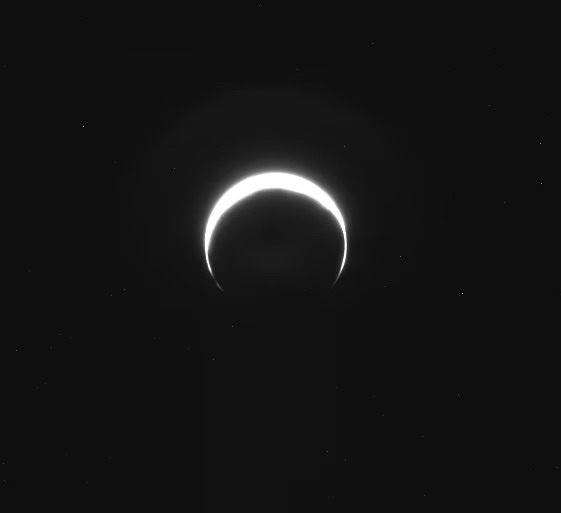
Image: NASA Solar System.
The image was taken on May 13 and published by NASA on the social media platform X. The agency explained that the irregularities on the edges of the crescent are likely related to the terrain features, as well as dust and clouds in the Martian atmosphere. The Psyche flyby past Mars is scheduled for May 15. The spacecraft will approach the planet at about 4,500 km, traveling at a speed of approximately 19,848 km/h. This maneuver is necessary not only for imaging: during the approach, the mission team checks and calibrates the spacecraft's scientific instruments to ensure they are ready for the main part of the expedition.
The primary goal of the Psyche mission is to explore the eponymous asteroid 16 Psyche in the main asteroid belt between Mars and Jupiter. According to the plan, the gravitational maneuver at Mars is intended to change the trajectory and increase the spacecraft's speed so that it can reach its destination by 2029.
In the editorial's opinion, the Psyche image has become not only a stunning space shot but also a reminder of how unusual familiar planets can appear when viewed from a different angle. The NASA mission itself demonstrates that humanity continues to take increasingly ambitious steps toward exploring the most mysterious objects in the Solar System.














Leave a comment