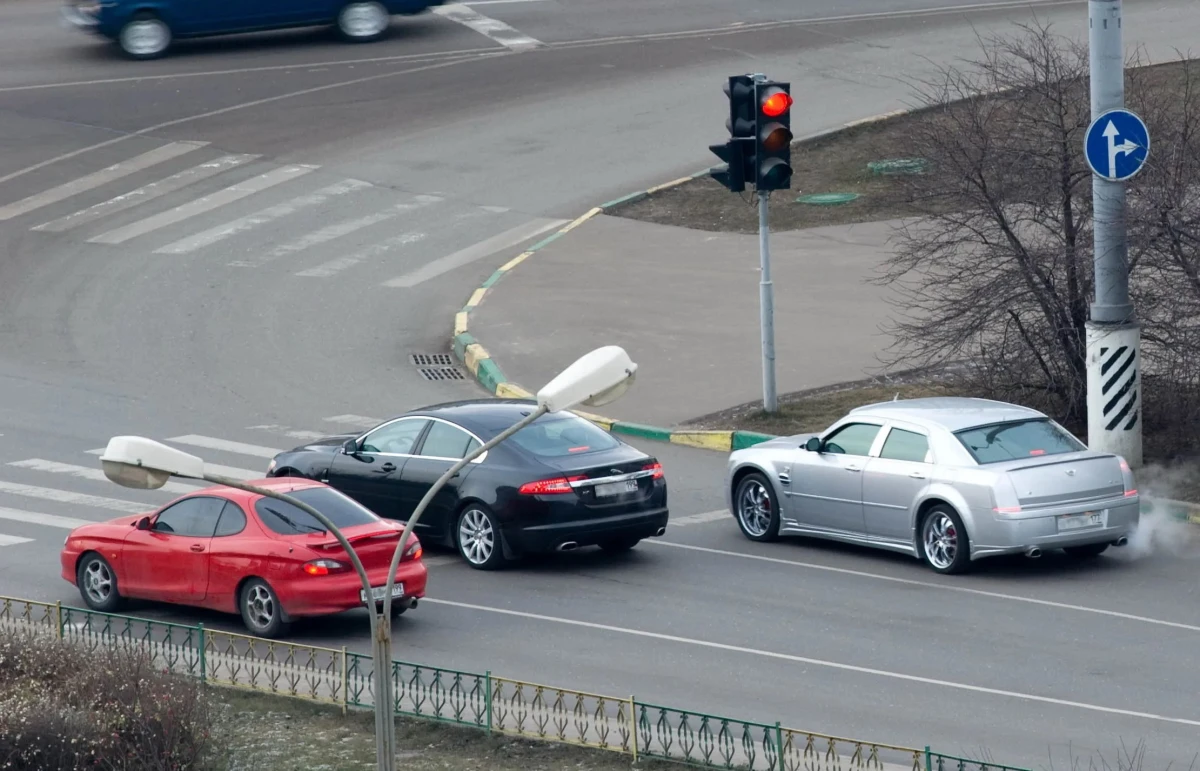
Every driver has noticed: someone speeds through intersections, but a few minutes later, they are right next to you again. Researcher Conor S. Boland from Dublin City University explained why this happens.
Every driver has found themselves in a situation where either you were in a hurry, crossing intersections at high speed, only to see the same cars around you later. Or you chuckled to yourself while catching up to someone who zoomed past you at the previous traffic light.
The Law of Traffic
As Slashgear writes, Dr. Boland referred to the phenomenon as the "Voorhees Traffic Law," inspired by the villain from the "Friday the 13th" movies, Jason Voorhees. Recall that in the film, he always catches up to his victims, even moving at a pedestrian's speed.
According to Boland, it all depends on the traffic lights. If two cars are moving at different speeds after passing a traffic light, the distance between them can change significantly depending on the operation of the traffic light, the color and duration of the signals, and the time required for a complete cycle of each traffic light. In some cases, traffic lights can completely negate the distance between two cars, preventing even the fastest driver from pulling ahead significantly.
Do slower cars ultimately catch up to faster ones? Research shows that it depends on the type of traffic lights. If the traffic lights operate on a set cycle (or if cars hit the so-called "green wave"), cars will catch up and distance themselves from each other at the same rate, and the car that is ahead will usually remain ahead.
However, if cars encounter independent traffic lights that are not synchronized, calculations show that the slower car is almost guaranteed to catch up to the faster one.
The probability of "catching up":
-
after 1 traffic light — about 42%;
-
after 3 — already 78%;
-
after 8 — more than 98%.
The characteristics of urban driving, with its short segments, mean that a slower car is more likely to catch up to a faster one than in rural areas.
Of course, these calculations and conclusions assume that both cars are moving at a constant speed throughout the journey. Most cars do not do this, especially considering that they accelerate at green lights and slow down at red ones. But Boland's research still gives drivers some insight into why it may sometimes seem like another driver is constantly catching up to you, or that you are always catching up to the same car.
The so-called "race with traffic lights" is often pointless: urban infrastructure levels the playing field for drivers. In the end, it is not the one who accelerates faster that wins, but the one who drives calmly and predictably, writes bb.lv.