
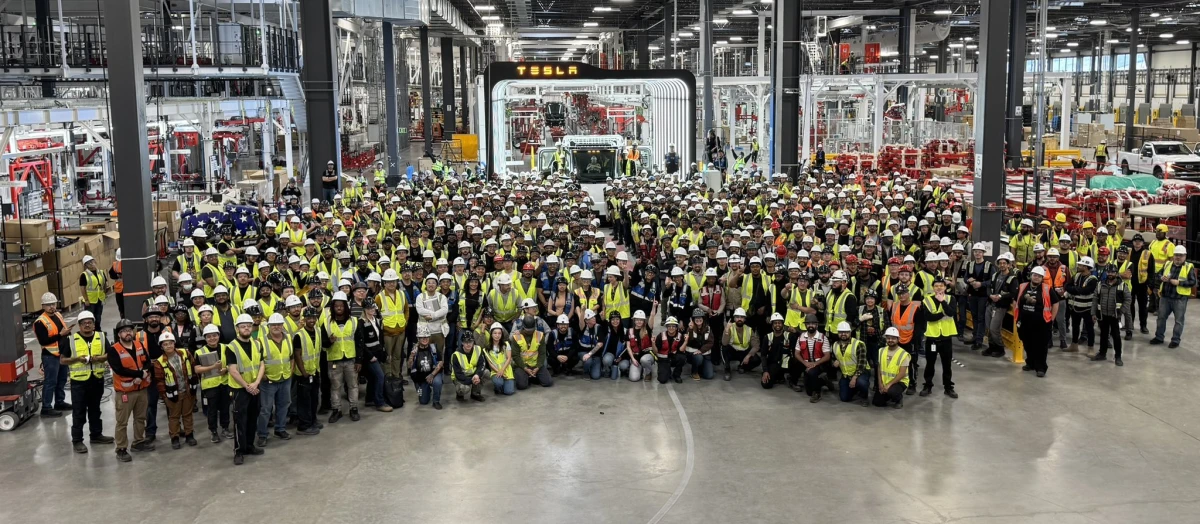
Last week, Tesla published a photo of the team at the new facility in Nevada against the backdrop of the first serial example of the Tesla Semi.
As a prototype, the vehicle was presented back in the fall of 2017, but it turned into a "long-term construction" project, second only to the second generation Roadster in terms of delays.
It was expected that the serial production of the Tesla Semi would begin in 2019, but the timelines gradually shifted, and only at the end of 2022 did the company deliver several trucks to PepsiCo's logistics division for trial operation. Since then, small-scale assembly of the Semi continued on an experimental line in Nevada, while a full-fledged facility for mass production of the Tesla Semi was being built next door.
First Semi off high volume line pic.twitter.com/fI1AdQrJFH
— Tesla Semi (@tesla_semi) April 29, 2026
By February of this year, Tesla had approved the specifications and configurations of the serial vehicles. The standard version, capable of traveling with a load of 37 tons up to 520 km without recharging, is offered to customers for $260,000, while the variant with a range of 800 km costs $290,000.
For the American market, these are the lowest prices for electric highway tractors of this class. Both versions have a power of 1,072 hp and support fast charging from a terminal with a power of 1.2 MW, allowing for up to 60% of the range to be restored in about 30 minutes.
The new facility in Nevada, where the serial assembly of the Tesla Semi begins, is designed for 50,000 vehicles per year. The company will gradually increase production volume. It is expected that between 5,000 and 15,000 units will be assembled this year. An advantage of this site is its proximity to the production location of traction batteries.














Leave a comment