For a long time, the scientific community believed that the terrestrial planets formed in the heated inner part of the Solar System. This raised questions about the origin of water and volatile elements on Earth, leading to the emergence of the mixed origin hypothesis.
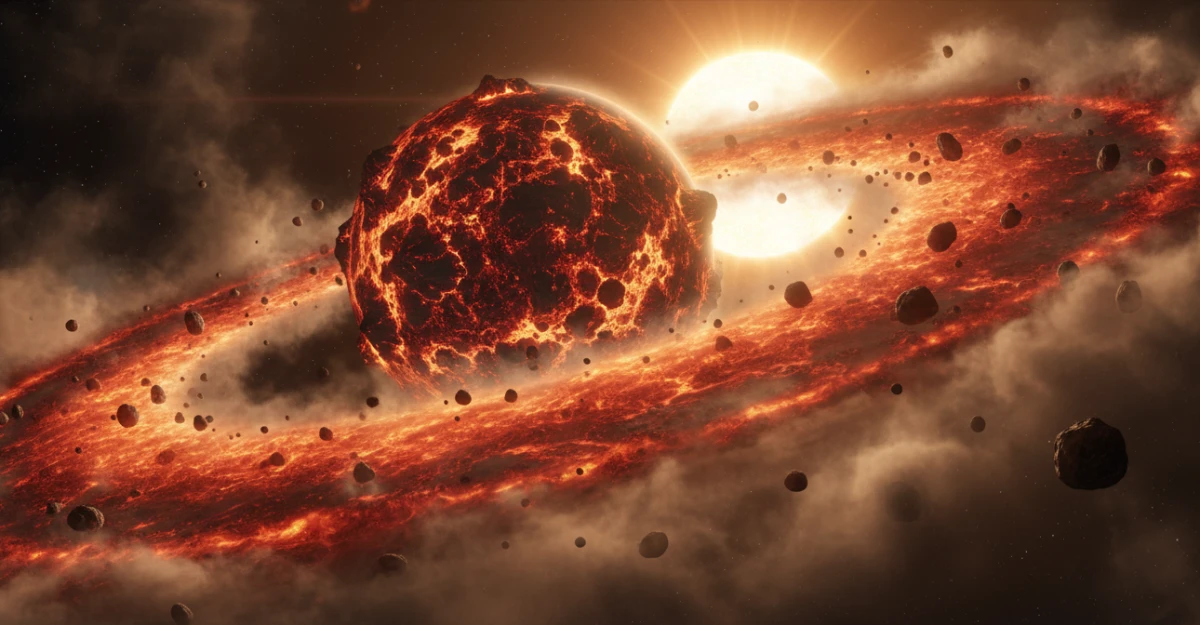
According to the established theory, the terrestrial planets, including our own, formed in the hot inner region of the Solar System, near the young, blazing Sun. In such extreme conditions, light and volatile elements should have evaporated, leaving only dry, rocky material.
The presence of water, carbon, nitrogen, and other volatiles on Earth required a convincing scientific explanation. To resolve this paradox, scientists proposed the mixed accretion hypothesis.
It suggested that Earth initially formed from local dry material but then underwent intense bombardment by meteorites. These cosmic visitors, arriving from the cooler outer regions of the Solar System, were believed to have delivered the missing chemical elements to the planet.
However, a fresh study by Swiss geochemists Paolo Sossi and Dan Bauer, published in the prestigious journal Nature Astronomy, completely disproves this long-standing model. By analyzing the isotopic composition of meteorites and terrestrial rocks, the scientists convincingly demonstrated that Earth formed exclusively from material in the inner Solar System.
Thus, there is no longer a need to invoke material from distant corners of space to explain its unique chemical composition.
Isotopic Chronicle: The Mystery of Classification
To uncover the mysteries of planet formation billions of years ago, scientists meticulously study isotopic anomalies. Isotopes are atoms of the same chemical element that differ only in the number of neutrons in their nuclei, which affects their mass.
The ratio of these isotopes in any substance remains unchanged since its formation. This serves as a sort of chemical fingerprint that reveals in which star's core or as a result of which cosmic process the atoms originated before entering the protoplanetary disk around the young Sun.
Planetologists, studying meteorites that reach Earth, have identified two key categories reflecting the isotopic dichotomy of the Solar System. These include non-carbonaceous meteorites (NC), which formed in the warm inner part of the system.
The second group consists of carbonaceous meteorites (CC), which formed in distant orbits, beyond modern Jupiter, and retained significant amounts of volatiles.
The main challenge was that the silicate shell of Earth, meaning the entire mass of the planet excluding the metallic core, could not be unequivocally assigned to either of these categories. When analyzing the isotopes of titanium or chromium, mathematical models indicated that Earth consists of approximately 6% external (CC) material mixed with local (NC) material.
However, when the same logic was applied to heavier elements like molybdenum, the equations demonstrated that the share of external material should reach around 40%. This mathematical inconsistency triggered a serious crisis in planetology.
It is physically inconceivable for a planet to contain 6% foreign material based on one chemical indicator and 40% based on another. In an attempt to save the mixed origin model, theorists proposed hypotheses about the existence of some intermediate, now-extinct classes of meteorites.
Alternatively, they suggested that Earth's core formed fundamentally differently than its surface. As a result, the theory became increasingly cumbersome and convoluted.
A New Approach: Multidimensional Analysis Instead of Binary Mixtures
The authors of the new study, Paolo Sossi and Dan Bauer, managed to identify the key reason for these contradictions. All previous scientific conclusions were based on the simultaneous analysis of only one or two isotopic systems.
Sossi and Bauer radically changed the approach by analyzing data from ten different isotopic anomalies at once. Their extensive database included elements with completely diverse physical and chemical properties: calcium, titanium, chromium, iron, nickel, zinc, molybdenum, zirconium, and ruthenium.
To process such a colossal volume of information, the scientists employed the method of Bayesian latent factor analysis. This powerful algorithm can identify hidden patterns in multidimensional space while accounting for measurement errors of each sample.
The results of this deep analysis turned out to be mathematically impeccable. The algorithm clearly demonstrated that if the parameters of all known non-carbonaceous meteorites in the inner Solar System are plotted on a graph, they form a clear linear relationship.
The isotopic composition of Earth perfectly fits into the direct continuation of this relationship across all ten investigated chemical elements.
Homogeneous Accretion and a New View of the Protoplanetary Disk
The researchers concluded that the chemical composition of Earth fully corresponds to the characteristics of material inherent to the inner Solar System. Computer simulations conducted during the study convincingly showed that the maximum share of carbonaceous (external) meteorites in the mass of our planet does not exceed 0.1%.
This means that the hypothesis of mass delivery of materials from distant space is no longer needed to explain Earth's unique properties. Moreover, this study confirms the model of homogeneous accretion.
According to this model, the material from which the planet formed did not change its isotopic composition over time. The substance that sank to the center and formed the iron core initially possessed the same isotopic characteristics as the material that remained on the surface as mantle and crust.
But how then can the differences between the meteorites of the inner group and Earth be explained? The scientists propose a radical reconsideration of our understanding of the structure of the protoplanetary gas-dust disk. For a long time, it was believed that planets formed from discrete, clearly separated classes of asteroids.
However, new data convincingly show that the protoplanetary disk possessed a continuous chemical gradient. The concentration of various isotopes gradually changed depending on the distance from the Sun.
The meteorites that scientists find today are merely random fragments formed on narrow, specific orbits. Earth, as a large body, absorbed the entire available spectrum of material on its orbit.
Its chemical composition represents an exact average value of the local section of the protoplanetary disk.
New Horizons: Predicting the Composition of Unexplored Planets
A key aspect of any advanced scientific model is its ability to make testable predictions for the future. The model developed by Sossi and Bauer provides just such an opportunity, detailing the architecture of the entire inner Solar System.
The researchers found that the isotopic distance between already known objects—Earth, Mars, and the asteroid Vesta—strictly mathematically correlates with the radius of their orbits and their mass.
The distribution of mass and chemical characteristics in the early Solar System follows a Gaussian function, or normal distribution, with its peak located near the modern orbit of Earth. Since the parameters of Earth and Mars perfectly match this distribution, the scientists were able to calculate the expected isotopic composition of Venus and Mercury.
To date, humanity has no confirmed soil samples from these planets, so their exact chemical composition remains an unsolved mystery. According to the calculations of the Swiss researchers, Venus and Mercury lie at the far edges of the identified distribution.
This suggests that their isotopic characteristics should be significantly more extreme compared to those of Earth. These planets formed under conditions of incredibly high temperatures and gas instability, in close proximity to a young star.
The accuracy of these mathematical predictions can only be verified by science in the coming decades, when space agencies conduct missions to collect and deliver soil samples from Venus and Mercury. However, the analysis conducted already puts a definitive end to one of the longest-running debates in Earth sciences.
Our planet, it turns out, formed exclusively from local material, and all its subsequent evolution was predetermined by the initial conditions on its own orbit.