
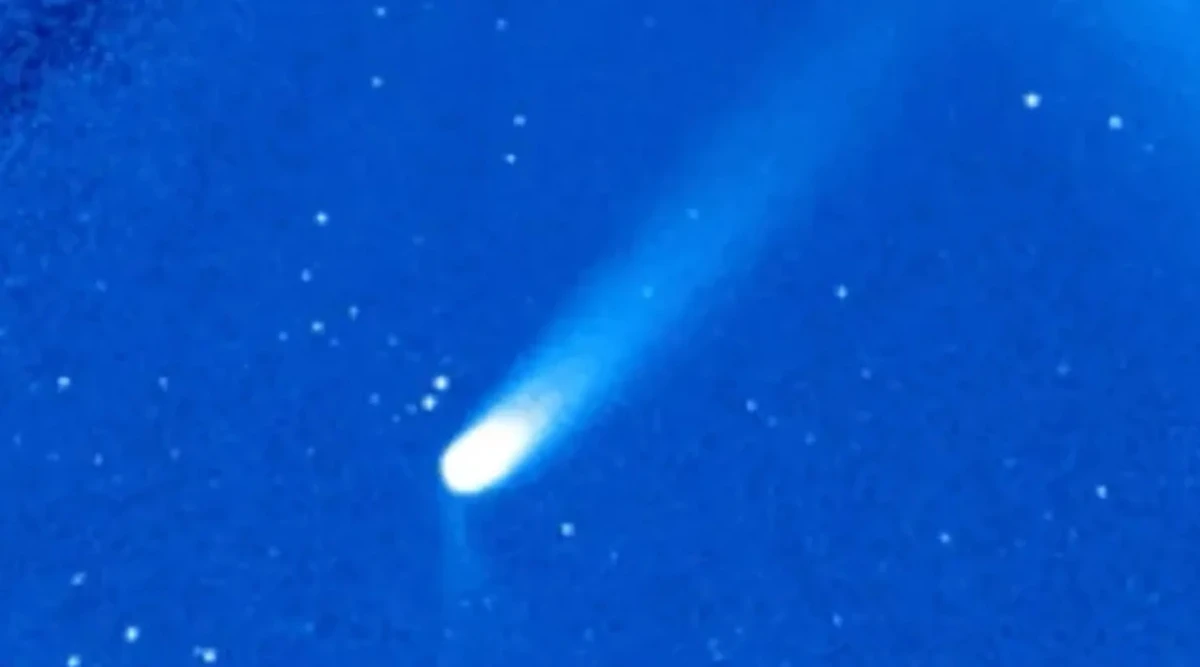
The comet C/2025 R3 (PanSTARRS) developed an ion tail when it approached at its closest distance to Earth – 72 million kilometers.
The Solar and Heliospheric Observatory (SOHO), a spacecraft that observes the Sun, captured images of comet C/2025 R3 (PanSTARRS) when it developed a second, ion tail during its closest approach to Earth on April 27, reports Focus.
The long-period comet C/2025 R3 (PANSTARRS) was first discovered in September 2025. This comet has approached the Sun and Earth at a maximum distance for the first time in 170,000 years. The first event occurred on April 20, and the second on April 27. This icy object is now heading back to the outskirts of the solar system, set to return in another 170,000 years.
The SOHO spacecraft, which conducts observations of the Sun, took pictures of the ion tail of comet C/2025 R3 (PanSTARRS), which is different from its usual dust tail. The ion tail appeared when the comet was at its closest distance to Earth – 72 million kilometers. This is almost half the distance between our planet and the Sun.
Comets are objects made of ice and rock. As they approach the Sun, the ice heats up and melts, causing frozen materials from the comet's nucleus to escape. However, the ice does not turn into liquid; it directly transitions to a gaseous state. This process is called sublimation of ice. Therefore, the comet ejects gas and dust into space. Heavier dust particles are pushed away by sunlight and the stream of charged particles from the Sun. This leads to the formation of the well-known dust tail of the comet. It reflects sunlight well and can be millions of kilometers long.
At the same time, ultraviolet radiation from the Sun strips electrons from gas molecules in the coma (the gas envelope around the nucleus) of the comet. This process is called ionization. These charged particles are then captured by the solar wind, forming a second, more direct but smaller ion tail.
The ion tail is always directed away from the Sun, as it moves under the influence of the solar wind, which travels at hundreds of kilometers per second. Larger particles that make up the dust tail move at a slower speed and thus lag behind the particles of the ion tail as the comet moves.














Leave a comment