
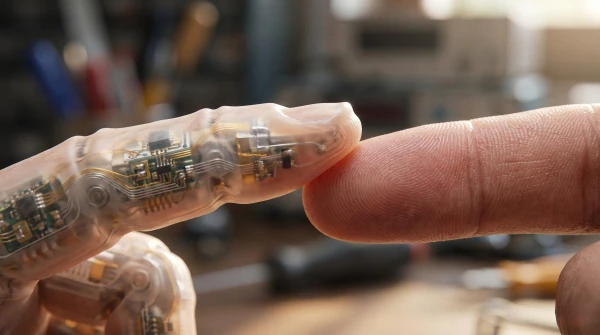
Finnish scientists have made a breakthrough by creating flexible electronic skin from wood materials. This will allow robots and prosthetics to sense the world, bringing them closer to humans and making them more eco-friendly.
Finnish scientists are making a real breakthrough by creating unique flexible electronics. This material, capable of stretching, allowing light to pass through, and conducting electricity, is set to become a revolutionary artificial skin for robots and prosthetics. Its main purpose is to provide sensitivity to touch, enabling soft robots to safely interact with people in hospitals.
Revolutionary Skin for Robots and Prosthetics
The inspiration for this wonder of nature comes from researchers at the University of Turku, who drew directly from the leaves of trees. Just as the veins in a leaf distribute the load while maintaining lightness and flexibility, the new engineering material allows for stretching, folding, and bending without losing transparency, breathability, and conductivity.
Under the careful guidance of Vipul Sharma, an associate professor in the Department of Materials Engineering at the University of Turku, his team aims to create not just convenient, but truly eco-friendly flexible electronics. Unlike traditional rigid components that rely on complex supply chains, Finnish scientists are seeking an alternative that retains all necessary properties while significantly reducing harm to our planet.
First Steps: Sensitive Robotic Hand
This innovative material has already undergone initial tests as electronic skin for a robotic hand. Scientists successfully attached a flexible layer to the manipulator, integrating sensitive pressure sensors into it. With every touch to the surface, the sensors reacted instantly, providing the robot with vital tactile feedback.
This is a colossal step forward for soft robotics and prosthetics! The artificial surface is now not just a shell; it can read touches and help the device navigate the surrounding world. In the future, such electronic skin will allow prosthetic users to feel pressure, temperature, and even humidity, opening new horizons of perception.
A New Level for Prosthetics: Touch Returns
Although modern artificial limbs already perform complex movements masterfully, their sensitivity still leaves much to be desired. People often have to rely on vision to control the prosthetic, as it does not convey familiar tactile signals about the force of contact. The new flexible sensory shell promises to bring prosthetics closer to the natural, intuitive functioning of human skin.
Such materials are also vital for soft robots. Unlike their rigid industrial counterparts, soft systems are specifically designed for safe interaction with humans. They can bend under load, easily endure physical contact, and adapt remarkably well to the most challenging conditions.
Soft Robots: Safety and Adaptability
Imagine: in a hospital, such a robot could gently assist in lifting patients or actively participate in limb rehabilitation. In industry, it could carefully handle fragile items without causing them harm, and in rescue operations, it could penetrate the narrowest and most inaccessible places where rigid machinery simply cannot reach.
An important part of the project is the desire to replace silicone components with more eco-friendly alternatives. Scientists are eager to reduce the ecological footprint of robotic systems while not sacrificing their functionality. For Finland, this is also a strategic raw material issue: the team is actively exploring the possibilities of creating electronics based on biomass from local wood.
Finnish "Oil": Wood as the Key to the Future
This innovative approach could significantly reduce the country's dependence on imported materials, opening up a completely new, high-tech future for the Finnish woodworking industry. Vipul Sharma aptly compares Finnish forests to "oil," emphasizing that the abundance of wood provides the country with unique raw materials for creating high-value-added materials. If biomass from Finnish wood can replace some of the imported components currently sourced from China, flexible electronics will not only take on a new form but also gain a much more transparent and sustainable production chain.














Leave a comment