
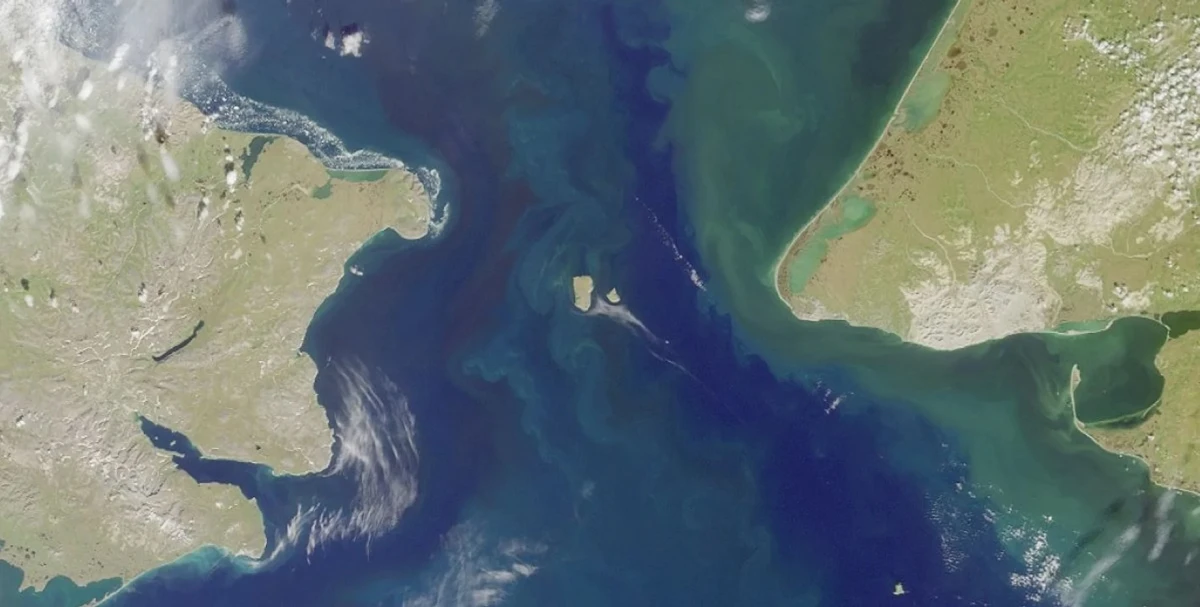
Researchers have stated the need to close the Bering Strait — it is believed that such a desperate step could prevent the collapse of the planet's main ocean current.
The Atlantic Meridional Overturning Circulation (AMOC) is an extensive network of ocean currents that transports warm water northward through the Gulf Stream. In recent years, scientists have increasingly expressed concern that global warming may weaken the AMOC, and in the worst-case scenario, even lead to its complete cessation. Some experts believe that a collapse could occur as early as the end of this century, writes Focus.
Previous studies have already shown that the shutdown of the AMOC would eventually lead to a sharp drop in temperatures in Europe — winters are expected to become, on average, 7°C colder. Fortunately, experts believe there is a way to prevent the collapse: the radical step involves closing the Bering Strait — an international waterway 82 kilometers wide that separates Russia and Alaska.
A new study was conducted by a team from Utrecht University in the Netherlands, and the scientists state that artificially blocking the Bering Strait would alter the freshwater balance in the system, acting as a stabilizer to prevent its collapse. However, there is a problem: the strait serves as a crucial shipping route connecting Europe and Asia, providing an important shortcut for cargo, energy resources, and research vessels.
In their work, the team used models to simulate the AMOC's response under various scenarios. According to the scientists, the basis of their analysis lies in the idea that the AMOC largely depends on the amount of freshwater in the system.
The opening of the Bering Strait means that Pacific freshwater can flow northward, diluting the salinity of the current and weakening it. On the other hand, closing the strait would increase the salinity of the North Atlantic, ensuring the preservation of the Atlantic Meridional Overturning Circulation instead of its destruction.
As a result, the scientists propose building a mega dam across the strait that would completely block water exchange between the Pacific and Arctic Oceans. The project envisions a dam width of about 80 kilometers and includes a barrier raised above sea level, approximately 100 m wide at the top.
The authors claim that the project is technically feasible, as the strait is shallow and relatively narrow, and comparable to existing projects such as land reclamation or large breakwaters. But the scientists warned that their project would only be effective if implemented before the AMOC significantly weakens. The project is also expected to have a "significant impact" on local ecosystems.














Leave a comment