
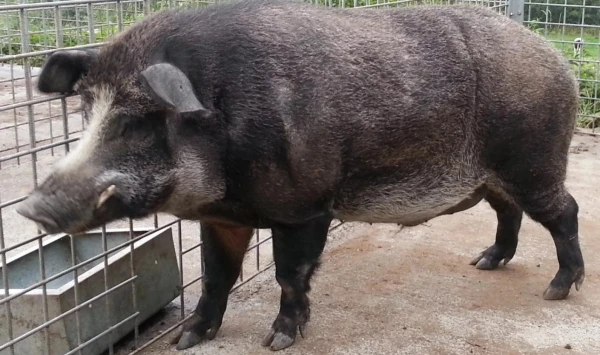
In the years following the disaster, some lines managed to go through five generations.
After the incident at the Fukushima nuclear power plant in Japan, nature quickly reclaimed the surrounding lands, and among other consequences, an unexpected biological experiment began: domestic pigs from abandoned farms started to interbreed with wild boars that inhabited the area. Scientists received a rare opportunity to observe mass hybridization without any anthropogenic influence, and a decade later, the analysis of these animals' genes turned out to be surprising.
The results of the work, conducted under the guidance of scientists Donovan Anderson and Shingo Kaneko, have the potential to change the perspective on the evolutionary dynamics of such processes. The researchers tracked two types of genetic markers. The first is mitochondrial DNA, which is passed exclusively through the maternal line, while the second is inherited from both parents. The initial hypothesis suggested that the genes of domestic pigs would establish themselves in the wild population and possibly even give it an advantage due to the heterosis effect.
In those individuals carrying the mitochondrial DNA of pigs, the nuclear DNA of these animals was present in negligible amounts. The maternal line stubbornly indicated descent from feral farm pigs, while the majority of the hereditary material had already been displaced by boar DNA. The explanation for this paradox was found in the difference in reproductive biology.
Wild boars typically give birth once a year, while domestic pigs can produce offspring several times during the same period. As a result, in the years following the disaster, some lines managed to go through five generations since the first crossbreeding.
"Although there were previous assumptions that the interbreeding of wild boars and feral pigs could stimulate population growth, this work, based on a careful analysis of the consequences of the Fukushima nuclear power plant disaster, indicates that the rapid reproductive cycle of domestic pigs is passed down through the maternal line," comments Shingo Kaneko. Even if the specific genes of domestic animals do not ultimately establish themselves, the short-term acceleration of reproduction can significantly impact the dynamics and spread rate of the mixed population.












Leave a comment