
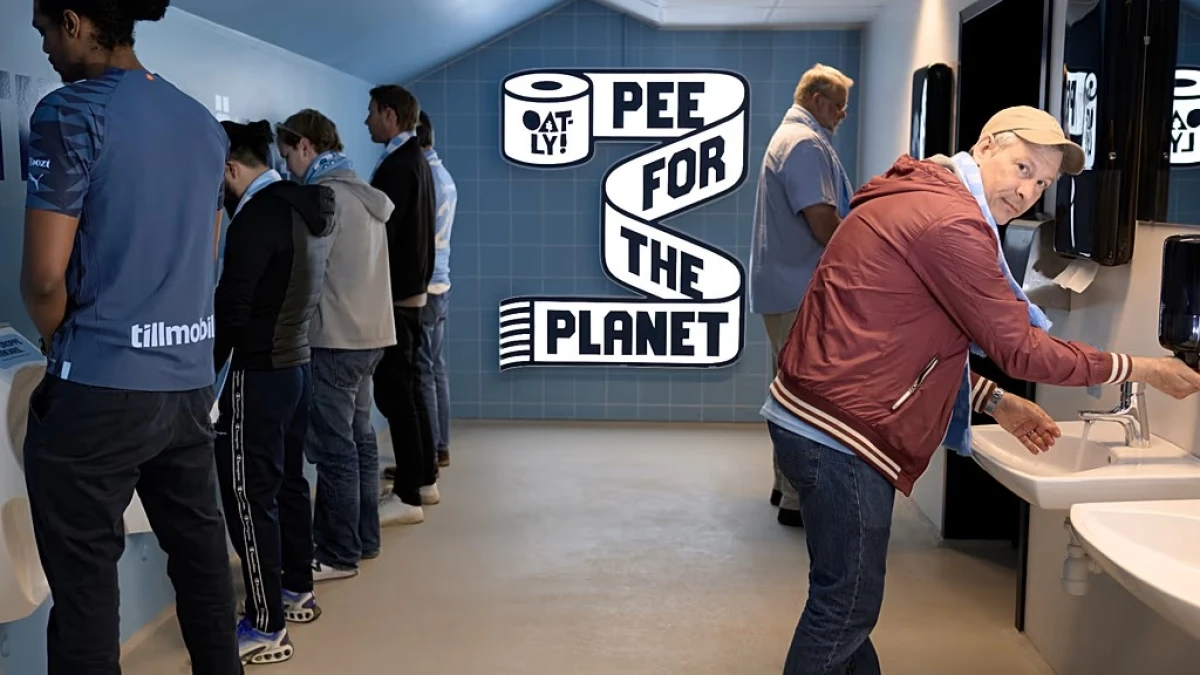
Can urine help resolve the fertilizer crisis in Europe? Swedish football fans are heading to the toilets in search of an answer. This year, Swedish football fans will participate in an unusual tournament, held under the slogan: "Pee for the Planet."
On Sunday (May 24), the Eleda Stadium, where Malmö plays, will open its doors and restrooms for an initiative aimed at collecting 1,000 liters of human urine.
The goal? To overcome Sweden's dependence on imported fossil fuel-based synthetic fertilizers. According to research by the Center for International Environmental Law (CIEL), these nitrogen fertilizers produce 1.13 billion tons of CO2 equivalent annually, exceeding the emissions of the entire aviation sector.
While these emissions have long been a concern for climate experts, in recent weeks, synthetic fertilizers have come under additional scrutiny as geopolitical instability threatens supplies.
Due to Iran's continued blockade of the vital shipping route of the Strait of Hormuz, about a third of the world's fertilizer trade has been suspended, jeopardizing agriculture and food security worldwide.
The strait is also key for transporting natural gas, which is necessary for producing synthetic nitrogen fertilizers widely used in Europe and beyond.
Is Human Urine a Viable Alternative to Synthetic Fertilizers?
Human urine is rich in the "big three" nutrients essential for plant growth: nitrogen, phosphorus, and potassium. These are also key ingredients in synthetic fertilizers.
The Swedish University of Agricultural Sciences (SLU), oat milk producer Oatly, Malmö FF, and Sanitation360 have joined forces to explore the possibility of using urine as a circular and safe alternative for fertilizing crops, for which they will process the urine collected at the stadium into fertilizer.
"This is about utilizing a resource that we are currently wasting," explained Björn Winnerås, a professor at SLU and an expert at Sanitation360.
"We also need to change our mindset because collecting and reusing urine is no stranger than recycling plastic. Today, we already use manure from cows, pigs, and chickens as fertilizer - and that is completely normal."
To implement the project, 15 urinals and one toilet capable of collecting urine have been installed at Malmö's home stadium.
From the start of the match this Sunday until Malmö's final home game of the Swedish season on November 29, the stadium will serve as a testing ground for urine collection technology, as well as hygiene, logistics, and public acceptance.
The study also assesses the safety of fertilizer derived from urine for food crops - a key issue given concerns about pharmaceutical residues and pathogens that must be eliminated before this approach can be widely adopted.
If successful, the project could open opportunities for adapting toilet infrastructure and developing future systems capable of collecting urine on a large scale.
It also has the potential to address another issue: the burden of wastewater treatment at large venues like a stadium with a capacity of 22,500 people. Some nutrients found in human urine are currently not recovered and end up in lakes and seas as pollutants.
Researchers estimate that, theoretically, urine could replace up to 30 percent of the synthetic fertilizers used in Sweden.
In the long term, researchers also intend to explore whether consumers are willing to accept food products produced using nutrients derived from urine.














Leave a comment