Some of these particles are retained by wastewater treatment facilities, but a certain amount still enters the environment.
Kitchen sponges – one of the most commonly used items in households – may be an underestimated source of microplastics. Scientists from the University of Bonn studied how many such particles are released during dishwashing and how this affects the environment. It turned out that sponges do indeed release a measurable amount of microplastics annually; however, the main ecological harm is not associated with this, but with water consumption.
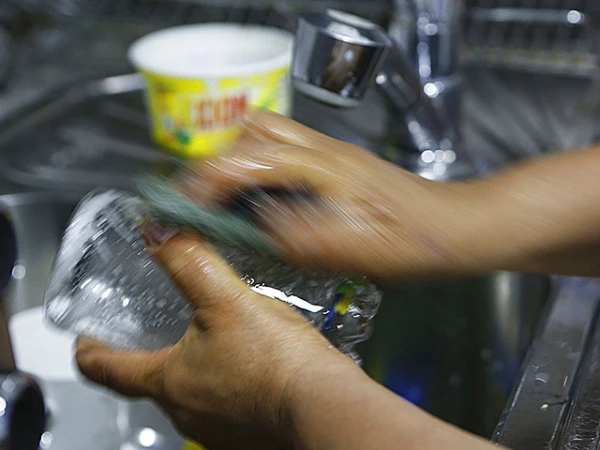
The study assessed the actual release of microplastics and its impact through life cycle analysis (LCA). The research combined laboratory experiments and a 'citizen science' approach: volunteers from Germany and North America used different types of sponges in their households and recorded the process. Sponges were weighed before and after use and were also tested in the laboratory using a device called SpongeBot, which simulates dishwashing.
The results showed that all sponges wear out and release microplastics – approximately from 0.68 to 4.21 g per person per year, depending on their composition. Sponges with lower plastic content release significantly less. Nevertheless, water consumption turned out to be the main factor of ecological impact during manual dishwashing.
Data obtained under real conditions allowed for a more accurate assessment of the scale of the problem. Although the amount of microplastics per person is small, on a national scale, it can reach hundreds of tons per year. Some of these particles are retained by wastewater treatment facilities, but a certain amount still enters the environment. At the same time, 85-97% of the total ecological impact is related to water consumption rather than microplastics.