
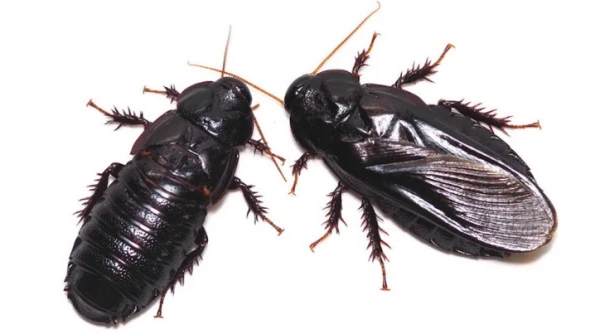
Selective aggression related to social context is common in animals.
We talked about the cockroaches Salganea taiwanensis a few years ago. They are exclusively monogamous; the male and female build a nest together in decaying wood, care for their offspring, and do not part for years. They have been found from time to time with chewed wings, but who could have done that? It turned out to be them: in 2021, a peculiar courtship ritual was described in the journal Ethology – after mating, cockroach pairs would eat each other's wings. Cockroaches, like many insects, are hosts to parasitic mites and mold fungi. By eating the wings of their partner, a cockroach helps rid them of parasites, keeping them healthy and ready to reproduce.
But grooming is not just hygiene; it also strengthens social bonds. A new article published in Royal Society Open Science describes an experiment with mating pairs of S. taiwanensis, to which a foreign cockroach, either a male or a female, was introduced. Some pairs were given time to post-copulatively eat each other's wings, while others were not. Both groups were placed in a nest where they could observe the intruder through a transparent partition. After a while, a door in the partition would open, and the intruder would enter the pair's space.
Those cockroaches that had eaten the wings energetically attacked the third cockroach, pushing it with their bodies and trying to make it leave. Both males and females did this, and they attacked both males and females. Out of several hundred attacks, in only 0.5% of cases did a cockroach push its partner, after which the attacks ceased – meaning the aggression was directed specifically at the intruder. The third cockroach could be larger and appear more 'dominant'; it could very well become a new mating partner – none of this mattered: the wingless cockroaches still tried to get rid of the intruder. In contrast, those pairs that still had their wings reacted to the third cockroach much more calmly, if not passively.
Thus, eating wings after mating serves as a sort of confirmation of the mating bond, or, if you will, a vow of eternal love and fidelity. The key here is not so much the eating of wings, but how the behavior of the cockroaches changes afterward. Selective aggression related to social context is common in animals, but, as the authors of the study note, it has not been observed among invertebrates until now.















Leave a comment