Within a few seconds of a gamma-ray burst, the energy released exceeds the total radiation of the Sun throughout its existence.
A Russian telescope located in Argentina has detected a rare event in the optical range — the flare of a dying star. This dying star emitted energy exceeding that of the Sun over its 10 billion years of existence.
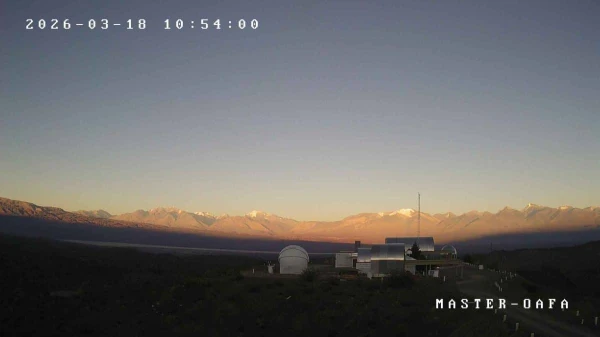
The FERMI space observatory registered the gamma-ray burst GRB 260207A. Soon after, the source of the gamma-ray burst was identified by the MASTER-OAFA telescope, reports the press service of Lomonosov Moscow State University.
Gamma-ray bursts (GRBs) are very bright and short cosmic flashes associated with the death of massive stars. Such phenomena occur in our galaxy approximately once every 10,000 years. Within a few seconds of a gamma-ray burst, the energy released exceeds the total radiation of the Sun throughout its existence. Due to their unusual brightness, these events can be seen from the farthest reaches of the universe.
Typically, gamma-ray bursts are detected by observatories operating in the gamma and X-ray ranges. Optical observations provide the most information about these events. When satellites detect gamma-ray bursts, they notify ground-based telescopes.
Aristarkh Chasovnikov, a junior researcher at the Space Monitoring Laboratory of the Geophysical Center of the Russian Academy of Sciences, explained that researchers have studied the behavior of gamma-ray burst light curves quite well within a few hours after the event. He noted that early observations are the most valuable. The parameters of the event — its brightness, duration, and decay characteristics — allow scientists to understand which star caused it and to gather data about the structure of the universe.