
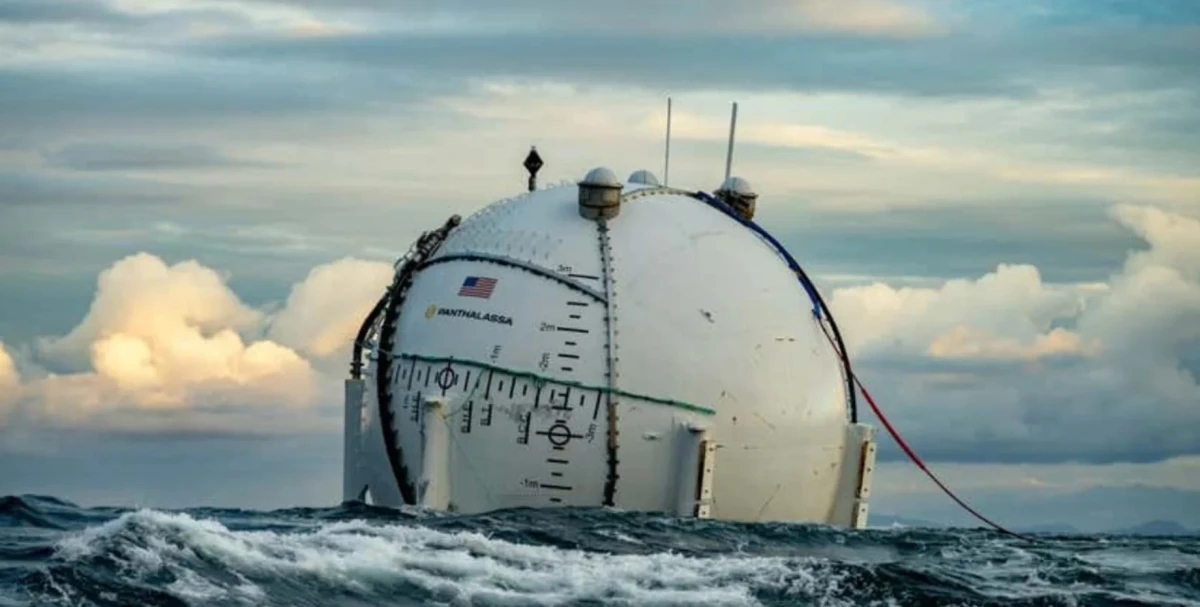
The American company plans to deploy autonomous data centers in the ocean. They will operate on wave energy and be used for AI operations. But experts point out that such technology may be inefficient.
Data centers powering AI already consume more electricity than some small countries. Experts believe that by 2030, they will consume 945 terawatt-hours per year. This is more than the total electricity consumption of Japan. AI consumes so much electricity that the American company Panthalassa believes data centers should be placed in the ocean, where wave energy could be harnessed. The company plans to start deploying its computing platforms in the ocean in the near future. However, experts say this technology may be inefficient, writes Focus.
Jonathan Kumi, a former researcher from Lawrence Livermore National Laboratory (USA), says wave energy can be used to generate electricity for floating data centers. But the harsh ocean environment will pose serious challenges for the equipment.
Panthalassa's floating data centers, shaped like a golf ball sitting on a tee, reach 85 meters in height and are made of sheet steel. They will be delivered on ships to their designated location in the ocean in international waters. There, the data centers will be able to generate their own electricity and support AI operations without being connected to the grid.
Inside the "tee" of the platform is a long pipe, open at the bottom. As the waves lift and lower the structure, seawater flows through the pipe and rises into the spherical part, which is hollow and mostly filled with air to float. The water spins turbines that generate electricity to power onboard graphics processors, other computing equipment, and satellite communication equipment.
Conventional data centers use vast amounts of water to cool their equipment. Since the servers of Panthalassa's data centers are housed in airtight modules below the water's surface, the container's wall will act as a heat exchanger, dissipating heat into the surrounding cold water.
Panthalassa is trying to do what few have done before: operate data centers without technical support. Jacqueline Davis from the Uptime Institute, a global authority on data center performance, says that without technical support, the operation of floating data centers could be significantly complicated.
This could become one of the biggest challenges for Panthalassa. But there is another issue. The data processed on the floating platforms will be transmitted to users on land via Starlink satellites, which offer limited bandwidth and higher latency compared to fiber optic cables. However, most consumer AI applications, such as chatbots and search assistants, rely on quick response times and constant network connectivity.
Davis believes that floating data centers will likely struggle to compete with land-based ones. In addition to engineering challenges, companies need to prove that their ocean-based technology can economically compete with traditional data centers connected to power grids and fiber optic networks.













Leave a comment