
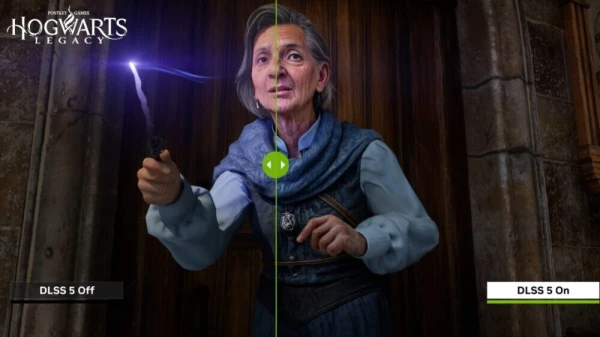
The changes in the appearance of the characters puzzled many users.
Nvidia, a globally renowned developer of graphics processors, chips, and software, has introduced the neural rendering technology DLSS 5. According to the creators, this innovation is set to revolutionize visual accuracy in video games. However, the reaction has been mixed, and RTVI.US explored the reasons behind this.
Nvidia's Position
As the developers assure, DLSS 5 is "the most significant breakthrough in computer graphics" since the advent of real-time ray tracing in 2018.
"DLSS 5 is the GPT moment for graphics: the combination of manual rendering with generative artificial intelligence provides a sharp leap in visual realism while maintaining the control necessary for artists to express their creativity," stated Jensen Huang, founder and CEO of NVIDIA.
The company released a trailer showcasing the difference when using the technology, which is set to be released in the fall. The video featured footage from modern AAA games like Hogwarts Legacy and Resident Evil: Requiem, whose characters noticeably changed towards realism with the new feature enabled.
Memes Galore
The changes in the appearance of the characters puzzled many internet users. Some hastily labeled DLSS 5 as another neural flop — low-quality, AI-generated content.
Reddit and other social media platforms were flooded with memes created in analogy to the "before" and "after" images of DLSS 5 in the trailer.
The situation is already being compared to when AI unsuccessfully redrew a pixelated portrait of Barack Obama, while others "tested" Nvidia's technology on Minecraft, making it frighteningly realistic.
Some Reddit users called DLSS 5 "an insult to art, the artist, the director, and every member of the development team." Others view the announcement as a publicity stunt since social media feeds are "teeming with memes," and there are still 7 months until the technology's release.
Expert Evaluation
At the same time, experts reacted positively to the announcement. Ryan Shrout, president and CEO of Signal65, a company that tests and analyzes technology performance, noted that he personally participated in testing DLSS 5. In his article, he mentioned "significant changes" in the visual component.
"This technology works with any rendering approach. It is suitable for both rasterized games and games with ray tracing and path tracing. And the higher the quality of the source data, the better the result. DLSS 5 does not replace quality rendering. It enhances it," emphasized the expert.
There are several months ahead for optimization and refinement, Shrout believes. Developers are just now gaining access to this technology, and they will need time to figure out the controls and find the optimal settings for their games, he stated.
The website Digital Foundry, which specializes in technical analysis of games and their corresponding software, notes realistic subsurface scattering in skin textures and more realistic hair rendering. Games like Resident Evil Requiem, Hogwarts Legacy, and Starfield demonstrate a leap in rendering accuracy, the publication claims.
"In games like Assassin’s Creed: Shadows and Oblivion Remastered, the realism of subtle, natural shadows and diffuse lighting has significantly improved, making objects in the scene look as they could not have appeared using the original renderer. Material processing can be astonishing: metals, fabrics, and even fruit peels look incredibly realistic," Digital Foundry emphasizes.
Todd Howard, head of the studio and executive producer of Bethesda Game Studios, which created series such as The Elder Scrolls, Fallout, and Doom, noted that he is eagerly awaiting the release of DLSS 5.
















Leave a comment