
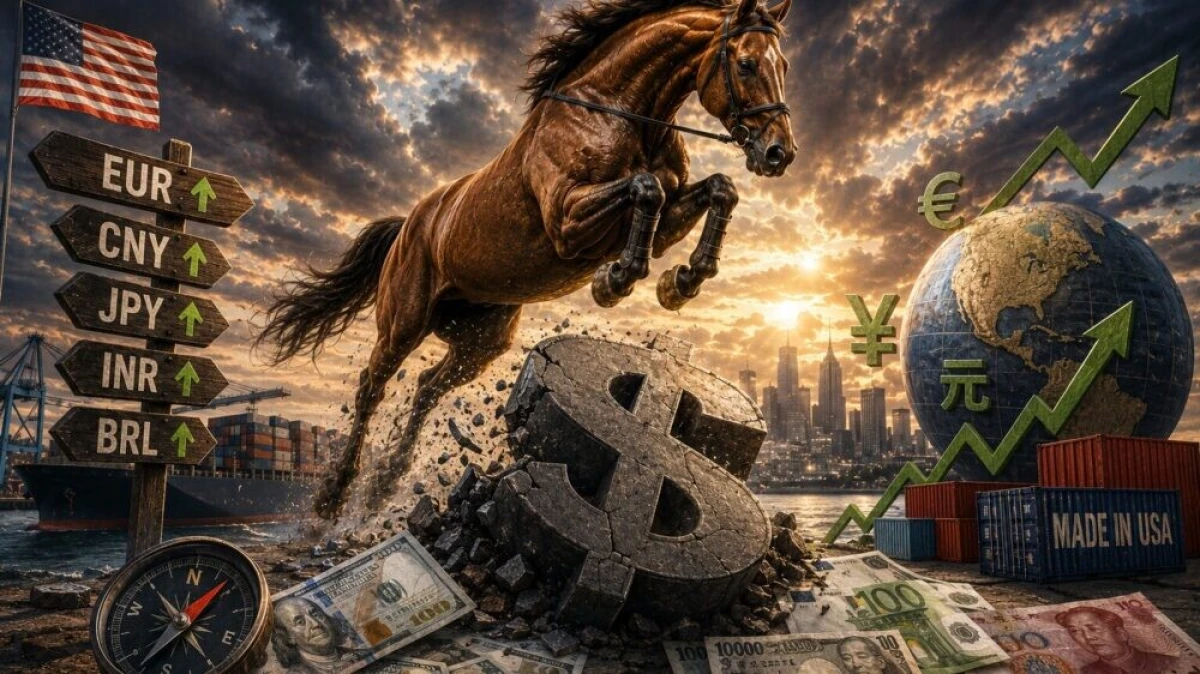
American companies that manufacture goods abroad are now facing increased costs.
The exchange rate of the US dollar against other currencies has fallen by about 10% since President Donald Trump returned to the Oval Office in January last year. In particular, in the first half of 2025, we saw the sharpest six-month decline of the national currency in over 50 years, although since last year the rate has remained roughly at the same level. While American presidents typically prefer a strong dollar, the current administration seems to favor a weaker rate.
While a strong dollar reduces the cost of imports, a weakening dollar stimulates American exports. In this situation, multinational corporations benefit. A weak dollar makes exports cheaper, meaning that companies selling goods abroad can profit from products that now cost less to produce.
On the other hand, American companies that manufacture goods abroad are now facing increased costs. Both of these consequences are a result of the political initiatives of the current administration. President Trump prioritizes encouraging the production of goods in the US, and a weaker dollar incentivizes companies to produce them domestically. Additionally, this administration is one of the most corporate-friendly in the history of the United States, as evidenced by President Trump's viewpoint on the matter: "With a weakened dollar, you can make a hell of a lot more money."
Developments in the conflict with Iran may also impact the future value of the dollar. Historically, the US dollar has been the sole reserve currency for global oil transactions. Current sanctions have accelerated the use of the yuan in the export of energy resources from Iran and Russia, which these countries use to circumvent the sanctions imposed against them. This weakens the dominant position of the US dollar in some trading markets in the Middle East and Asia. Watch how this will affect negotiations between the US and Iran. Any deal will almost certainly require the continued use of the US dollar as a reserve currency, while a resumption of hostilities will prompt Iran and its allies to invest more in the yuan, strengthening it at the dollar's expense.
According to Kenneth Rogoff, an economist at Harvard University and former chief economist at the International Monetary Fund, "the dollar is still significantly overvalued, and over the next five or six years, it could fall by 15%" as it is "in a 15-year bull trend." While the Trump administration may be intentionally creating ideal conditions for a weaker dollar, there have been moments during both Barack Obama's and Joe Biden's presidencies when the dollar fell even lower.
The weakening of the dollar should be evident to all Americans traveling abroad this season. Since the beginning of 2025, the dollar's exchange rate against the peso has decreased by 16%, and against the Swiss franc, South African rand, Danish krone, Swedish krona, and euro by 10–17%. However, we see only a slight impact on consumers regarding imported goods, as only about 5–10% of the currency's depreciation is passed on to them, while companies operating abroad are currently absorbing the remaining losses.
"Expect further price increases for foreign goods as the dollar normalizes to its average levels that existed before the 2020s," warns Gary Gorny, a financial planning economist, "If you are a consumer, prepare accordingly by purchasing foreign goods now, before further declines in the exchange rate, especially more expensive items like electronics and non-American-made cars, as well as higher-priced clothing—Italian suits, leather jackets, belts. If you represent a company, now is the right time to invest in the international market, as exports will yield additional profits due to the 'favorable conditions' associated with the cheaper goods and products of American manufacturing amid further dollar weakening.














Leave a comment