The separation of Europe from other continents is the question.
Geological models indicate that during the Permian period, around 300 million years ago, all of Earth's continents were encompassed by the supercontinent Pangaea. About 200 million years ago, Pangaea began to break apart into major parts: the northern Laurasia, which included Europe, North America, and Asia, and the southern Gondwana, which united Africa, South America, Australia, and Antarctica.
Unlike geologists, paleontologists have long suggested that Europe may have separated from Africa later than the rest of Laurasia, remaining connected to it until the Cretaceous period (145–66 million years ago), which marked the height of the dinosaurs. This means that terrestrial animals could freely move across land between the now-separated continents.
One argument in favor of the hypothesis of the existence of Eurogondwana is the significant similarity between the fossils of extinct crocodiles found in present-day Europe and species that existed at the same time in Africa and South America. If primitive crocodiles were related, it would indicate a later separation of Europe from the southern continents.
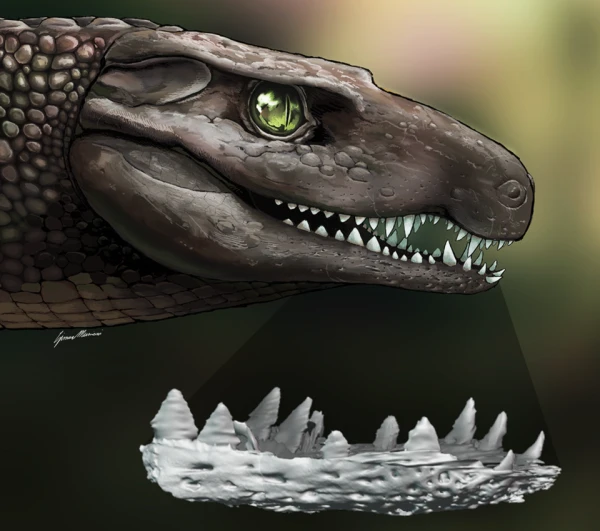
In Hungary, in Cretaceous rocks aged 85 million years, paleontologists found fragments of the skull and teeth of the extinct terrestrial crocodile Doratodon carcharidens. With a deep skull and serrated teeth resembling blades, it resembled a carnivorous dinosaur. Previously, these features were only found in African and South American species of primitive crocodiles, leading to the belief that Doratodon was an immigrant from the south, arriving in Europe over land, which was key evidence supporting the Eurogondwana hypothesis.
Then Marton Rabi from the Biogeology Department of the University of Tübingen (Germany) and his colleagues, paleontologists from Eötvös Loránd University (Hungary), found the upper jaw of Doratodon in the same layer. This allowed the researchers, whose article was published in Scientific Reports, to create a more complete portrait of the crocodile and challenge the hypothesis that during the age of dinosaurs, Europe remained connected to Africa.
The proportions of Doratodon's skull and teeth indicate that it was quite modest in size, only about 1.5 meters long, but rather fearsome in appearance: with long legs and a head resembling that of a dinosaur. This made Doratodon very similar to some extinct crocodile species from Africa and South America.
However, a comprehensive analysis of Doratodon's anatomical details and its evolutionary relationships showed that this crocodile is a close relative not of Gondwanan, but of other Laurasian crocodiles, the remains of which have been found in North America and Asia.
The researchers concluded that the similarity of Doratodon to African and South American crocodiles was a case of extreme evolutionary convergence. This term refers to the formation of similar traits in unrelated species that had to adapt to similar environmental conditions.
As Rabi explained, upon re-examining other European species from this period, including dinosaurs that were previously considered immigrants from Africa, it turned out that their origins also need to be reconsidered. These animals can be viewed as descendants of a once widely distributed ancestor from the time of the supercontinent Pangaea. This, according to the scientist, seems more likely than the idea that they were newcomers crossing continents and entering Europe from the south.
"Now we suggest an early separation of Europe—as part of Laurasia—from Gondwana in the Jurassic period, approximately 180 million years ago, which aligns better with geological models. Doratodon, in a sense, redrew the prehistoric map of Europe," the researcher concluded.