
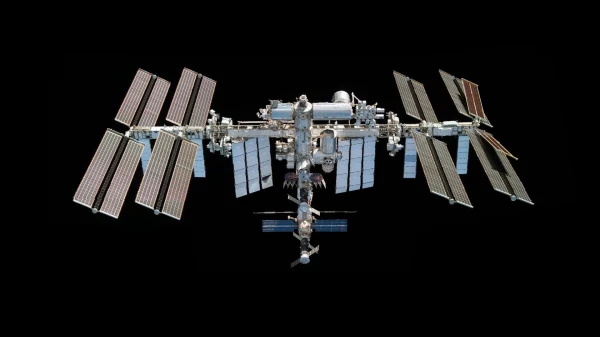
Otherwise, Americans risk being without a space base for some time.
In the U.S., there is a space commotion: the authorities do not know what to do with the ISS. According to the plan, the operation of the international station is supposed to end in 2030. In 2031, the American segment is to be dismantled, burned up in the atmosphere, and sunk in the Pacific Ocean.
Now, the Senate is considering the option of extending the ISS operation until 2032 or even longer. A bill has been developed to fund NASA with corresponding amendments — it has already received approval from the relevant committee.
Currently, Americans risk being without a space base for some time. The previous strategy was as follows: NASA focused on the Moon, while low Earth orbit was left to private companies.
However, the lunar program is going through tough times. In addition to the fact that the Artemis II mission to orbit the Moon has repeatedly failed to launch the SLS rocket, NASA, after the arrival of new leader Jared Isaacman, has completely revised its future plans for exploring Earth's satellite.
Previously, a manned landing on the Moon was expected during the Artemis III mission in 2027. But now it has become clear: there will be no landing module by that time. Neither Elon Musk nor Jeff Bezos will be able to prepare and test their spacecraft in time. Therefore, Artemis III is now turning into a test program: the Orion spacecraft in low Earth orbit will attempt to dock either with SpaceX's Starship HLS or with Blue Origin's Blue Moon. A person will be sent to the Moon "after 2028." That is, it is still unknown when.
To believe in the capabilities of private companies in the hope that they will independently build orbital stations that will immediately replace the ISS would be too naive. Projects for private stations exist. The company Vast is already conducting final assembly of the Haven-1 station.
But space is complex and expensive. Experience from previous years shows: private companies achieve great success in a short time only with NASA's support. Elon Musk created the highly successful Falcon 9 rocket and reusable Dragon spacecraft precisely thanks to NASA contracts: the agency prepared the technical specifications for the necessary services, announced a competition, selected a winner, and prepaid the launches.
The situation is similar with orbital stations. Haven-1 is an experimental station for short-term stays, consisting of one small module. By the standards of an independent company, this is a success and a breakthrough. But it cannot be a full replacement for the ISS.
Companies Axiom Space, Blue Origin, Vast, and Voyager are waiting for a similar competition for an orbital station. Without NASA's support, private companies are gradually attracting investor funds, but this is clearly not enough. Axiom Space raised $350 million in February 2026 (among the investors is Donald Trump Jr.), and Vast secured funding of $500 million. Private companies need motivation, clear rules of operation, and finances from the space agency. Therefore, the NASA funding bill from Senator Ted Cruz requires NASA to publish requirements for space stations within 60 days, publish a request for proposals for private companies within 90 days, and sign contracts with two or more orbital station developers within 180 days.
But even so, creating a worthy replacement for the ISS by 2030 is practically impossible. Therefore, the lifespan of the international station should be extended until 2032. Or even longer — until a full replacement is created. The likelihood that Russia will agree to extend the ISS operation is quite high. It is possible that Jared Isaacman will discuss this matter with the head of Roscosmos, Dmitry Rogozin, next summer: the NASA leader plans to fly to Russia and attend the next launch of the Soyuz spacecraft.











Leave a comment