
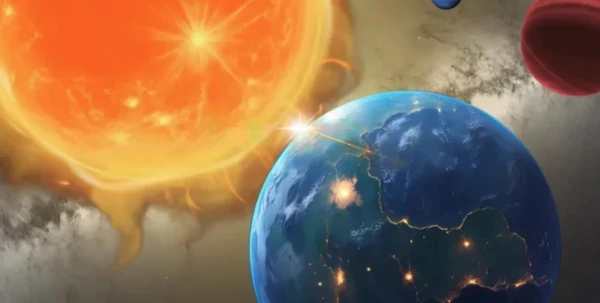
According to scientists, most planetary systems look like “peas in a pod.” But the TOI-201 planetary system, located 370 light-years away from us, is unique.
Using NASA's TESS space telescope, astronomers have discovered a new, very strange planetary system located 370 light-years away from Earth. Three planets orbiting the star TOI-201 have orbits that change so rapidly that astronomers can observe these changes in real time. Such behavior in a planetary system has never been seen before, writes Focus.
The star TOI-201 is 1.3 times larger in size and mass than our Sun. Three planets orbit around it, each having a different orbital period due to their varying distances from the star.
-
The closest planet to the star is a rocky super-Earth type. Its mass is about 6 times greater than that of Earth, and a year there lasts almost 6 Earth days.
-
Further out is a gas giant planet, whose mass is about 2 times less than that of Jupiter. Its orbital period is 53 Earth days, meaning a year there lasts less than two Earth months.
-
The outer planet of the TOI-201 system is a gas giant with a mass 16 times greater than that of Jupiter. A year there lasts almost 8 Earth years, indicating that the planet is very far from its star.
-
For comparison, the orbital period of Jupiter in the Solar System is nearly 12 Earth years, and the average distance from Jupiter to Earth is about 780 million kilometers.
According to scientists, most planetary systems look like "peas in a pod." This means that neighboring planets have similar parameters and are in a similar orbital plane. However, the TOI-201 planetary system contains three distinct planets with unusual gravitational interactions.
Changes in planetary systems and shifts in planetary orbits are not unique, but these transformations usually occur over millions or even billions of years. In this system, changes happen almost in real time, meaning they occur extremely quickly.
The outer planet in the TOI-201 system has a very elongated elliptical and inclined orbit. This gas giant attracts the two inner planets of the system with its gravity. As a result, the orbits of the inner planets shift, and their passage times against the backdrop of the star's disk also change. However, these changes are so extreme that in about 200 years, the planets will no longer align in front of their star at all. Their orbit will change so significantly.
Astronomers say that in the Solar System, almost all planets are in one plane, but in the TOI-201 system, each planet is unique. This indicates an active reorganization of orbits within the planetary system.













Leave a comment