
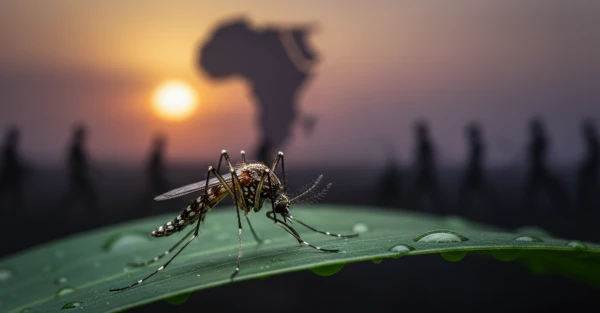
For a long time, it was believed that climate change was the main driver of the early history of Homo sapiens, determining its habitat. However, recent studies show that the invisible enemy — malaria — played no less, and sometimes even a more significant role in shaping the geography of ancient humanity.
It is traditionally believed that climate played a key role in the early history of Homo sapiens. Changes in temperature, water availability, and landscape transformations, such as the expansion of savannas or the advance of glaciers, shaped the ecological niche of humans, defining their habitat. However, an international group of scientists from the Max Planck Institute for Geoanthropology and the University of Cambridge presented new research indicating another powerful factor that influenced the geography of ancient humanity in Africa.
This factor was the spread of infectious diseases, primarily malaria. The researchers concluded that for the past 74,000 years, areas with a high risk of malaria transmission limited the settlement of ancient hunter-gatherers. This contributed to the isolation of populations from one another and even stimulated genetic changes in the human body.
Challenges in Studying Ancient Diseases
Studying the history of ancient diseases has always been fraught with enormous difficulties. To reliably confirm an infection in a population that lived tens of thousands of years ago, scientists need to extract the DNA of the pathogen from fossilized human remains. The main causative agent of malaria is the parasite Plasmodium falciparum.
However, the genetic material of this parasite is extremely fragile and almost does not survive in remains from the Pleistocene epoch. This severely limited the scientific possibilities, preventing the determination of the true impact of malaria on the lives of ancient people without direct DNA evidence. The authors of the new study found a workaround by applying a method of spatial ecological modeling. Instead of searching for traces of the parasite itself, they focused on the conditions necessary for the existence of its vectors. This refers to malaria mosquitoes, whose life activities directly depend on the environment.
How Spatial Modeling Works
The study is based on data about the current distribution ranges of key malaria vectors in Africa. These include the Anopheles gambiae and Anopheles funestus groups, as well as the Anopheles melas and Anopheles merus species, which breed in saline water. The life activities of these insects directly depend on climatic and ecological parameters.
They require specific temperature and humidity conditions, as well as a specific type of vegetation cover, which in the study was measured through a leaf area index. It is important to note that the ambient temperature also affects the development rate of the parasite within the mosquito. The scientists collected these modern ecological requirements and integrated them into paleoclimatic models.
These models allow for highly accurate reconstruction of climatic changes on the African continent at intervals of one or two thousand years, covering a period of up to 74,000 years ago. As a result, the researchers were able to calculate the "malaria stability index" for each historical epoch. This index reflects the ecological potential for sustainable and regular disease transmission throughout the year, considering the lifespan of the mosquito, its propensity to bite humans, and the incubation speed of the plasmodium.
Comparison with Archaeological Findings
After creating maps of malaria risk distribution, the scientists compared them with independent data on the settlement of ancient humans. For this, an extensive database of archaeological sites located throughout Africa was utilized. The locations of ancient settlements were also analyzed in light of climatic conditions, allowing for the identification of areas suitable for the lives of hunter-gatherers in various millennia.
The comparison of the two types of maps revealed a clear inverse relationship. For tens of thousands of years, the ecological niche of humans was predominantly located in areas with a low malaria stability index. Territories where the climate created ideal conditions for year-round transmission of the infection remained virtually uninhabited. People deliberately avoided areas with a high risk of disease. This territorial restriction also had serious demographic consequences. When the climate became wetter and warmer, areas of high malaria stability expanded. According to the models, these dangerous zones divided habitable territories into isolated patches.
For example, the regions between the Sahara and Ethiopia were separated by areas with a high risk of infection about 54,000 years ago, and then again around 8,000 years ago. The lack of safe migration routes between these patches hindered contact between human groups. The scientists emphasize that such isolation helps explain the formation of complex structures and high genetic diversity within African populations observed by modern biologists.
Malaria in Historical Perspective: New Discoveries
The results of the modeling allowed for a significant revision of several established anthropological theories. Firstly, the study revealed that one of the first significant peaks in malaria spread occurred between 60,000 and 50,000 years ago. This time remarkably coincides with the main wave of large-scale migration of anatomically modern humans out of Africa to other continents.
The expansion of malaria risk zones at this critical moment makes the assumption quite likely. Migrating groups were likely already familiar with the disease and carried the parasite to new territories with them. Secondly, new data convincingly refutes the widespread hypothesis of a direct link between malaria and the development of agriculture.
It was previously assumed that malaria became a serious problem for humanity only about 7,000 to 8,000 years ago, during the Neolithic Revolution. Scientists believed that the transition to a sedentary lifestyle, mass deforestation for crops, and the creation of artificial water bodies created an ideal environment for mosquito breeding, leading to an increase in morbidity. However, the current study demonstrates that the largest spike in malaria activity occurred much earlier, around 13,000 years ago, shortly after the end of the Last Glacial Maximum.
Global climate changes of that time created favorable conditions for the widespread distribution of infection vectors, without any human intervention. Hunter-gatherers faced immense pressure from this disease thousands of years before the first agricultural practices emerged.
Genetic Response to the Malaria Threat
Particular interest arises from the developments in West Africa between 14,000 and 10,000 years ago. The modeling clearly shows that during this time, the habitat of ancient humans began to actively overlap with areas characterized by a high malaria risk index. People began to explore zones that they had previously carefully avoided.
It is precisely during this time period, as independent genetic studies show, that the ancestors of the Bantu peoples in West Africa developed a unique mutation. This mutation causes sickle cell anemia, altering the shape of red blood cells. If a person inherits the mutated gene from only one parent, they do not suffer from severe anemia.
However, their altered red blood cells effectively prevent the reproduction of the malaria plasmodium in the blood. Thus, this mutation provides high survival rates in regions with malaria epidemics. The chronological coincidence of climate modeling data with genetic calculations convincingly confirms that the overlap of human habitat with malaria zones provoked a direct biological response.
The constant presence of the infection became a powerful factor of natural selection, solidifying these genetic changes in the population. The introduction of spatial modeling methods into archaeology opens new horizons for studying the impact of diseases on human development, even in the complete absence of ancient DNA of pathogens. This research convincingly demonstrates that infectious diseases were as significant a factor in shaping the history of our species as the availability of food resources or climatic fluctuations. The geographical distribution of pathogens directly controlled population density and migration patterns. It also influenced the processes of genetic adaptation of early Homo sapiens.













Leave a comment