
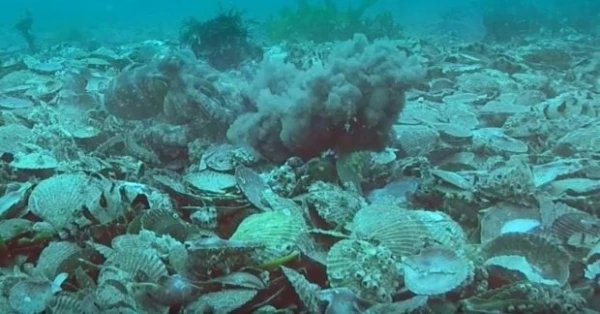
Researchers observing octopuses in densely populated areas recorded unusual behavior: the animals actively "threw" shells and silt. However, the true motives behind these actions turned out to be more complex than assumed, sparking heated discussions in the scientific community.
In April 2026, the internet was abuzz with a video showing a female octopus skillfully lifting a stone with its tentacle and hurling it at a male. This viral sensation was covered by the portal discoverwildlife, but it turned out that the social media post was hiding a much deeper investigation.
Although the video referenced real scientific work conducted in Jervis Bay off the coast of Australia, the true conclusions of the researchers were far more complex than they initially appeared. The gloomy octopus, or Tetrioctopus, is a typical inhabitant of eastern Australia and, like most of its relatives, prefers a solitary lifestyle. However, in Jervis Bay, there are two unique areas where these cephalopods gather in large numbers.
The reason for such gatherings is the abundance of food and ideal living conditions, which allowed researchers to observe their unusual social interactions.
Scientists carefully recorded the behavior of octopuses in these densely populated areas, noting that the animals regularly "threw" various objects such as shells and silt. The viral video on social media unequivocally claimed that females were deliberately throwing objects at bothersome males.
However, the scientific article published in the prestigious journal PLOS ONE presented a somewhat different interpretation of these events, delving into the details of octopus behavior.
Peter Godfrey-Smith, the lead author of the study, explained this phenomenon in detail: "Some octopuses exhibit behavior that can be described as a kind of 'reactive throwing' - at least, that’s what we call it."
He clarified: "The octopus collects shells, silt, and/or algae in its tentacles and uses a jet propulsion mechanism to throw the useful load some distance (often several body lengths). This is not a 'spit' because the material is held in the tentacles, but it is also not a typical throw - usually - because the energy comes from the jet (the 'siphon'), not from the tentacles themselves."
Interestingly, despite numerous recorded "throws" of material by octopuses, only in 33 percent of cases did these projectiles reach another octopus. During one hour of observation, for example, one female threw objects 17 times.
Of these 17 throws, only nine hit other individuals, indicating low accuracy or other purposes for such behavior.
Of the nine successful hits, eight were directed at a neighboring female, and only once did a projectile reach a male. In another episode, the same female made ten throws, five of which successfully hit the male.
This male, located in a neighboring den, was actively trying to mate with her. Interestingly, even the recording camera repeatedly became a target for the octopuses' projectiles.
Godfrey-Smith commented on these observations, explaining: "Most of these 'throws' did not hit other octopuses. Most of them seemed to be just cleaning the den."
He added: "We managed to capture one video where an octopus appeared to exert some force with its tentacles. Perhaps the shell was thrown a short distance, like a frisbee, and hit another octopus. But this was an unusual case - usually, the force comes from the siphon."
Researchers suggest that some of the recorded throws may have been intentional, serving to regulate social, including sexual, interactions between octopuses. However, they specifically noted the absence of any response from the "targets."
Moreover, some powerful throws were made into open water, without any visible target, which raises doubts about their aggressive nature.
Scientists warned about the difficulty of proving the true intentions of animals, suggesting that many hits could have been accidental. Perhaps the octopuses were simply cleaning their burrows, while other individuals accidentally found themselves in the trajectory of the throw.
Thus, while octopuses do demonstrate a rare ability to throw, we cannot definitively assert that females were intentionally throwing objects at bothersome males.
Amazing Discoveries About Octopuses
In the southern Pacific Ocean, scientists observing the underwater world witnessed a remarkable event. Their cameras, lowered to the seabed off the coast of Rotuma, captured something completely unusual.
Using a remote underwater video system with bait to count marine inhabitants, researchers unexpectedly recorded a "collision" between a fish and an octopus.
















Leave a comment