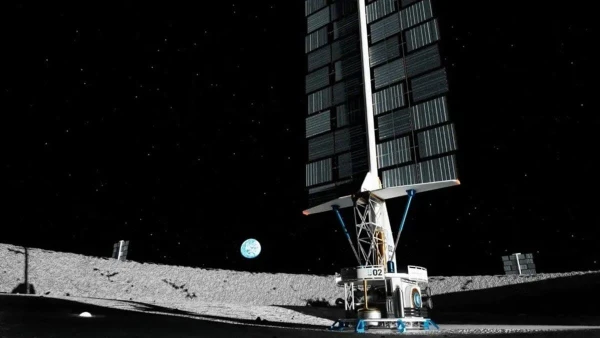
NASA is betting on a unified energy architecture capable of scaling from orbital platforms to lunar bases.
Lockheed Martin has bet on the development of a nuclear power system (Fission Surface Power, FSP) as a key element for ensuring long-term human presence and industrial activity on the Moon.
The American company advocates for a flexible, scalable architecture. Starting with compact systems of 5–10 kilowatts for the initial stages of exploration can reduce risks, and then gradually transition to systems of 25–50 kilowatts and eventually to reactors with a capacity of up to 100 kilowatts, capable of supporting a sprawling commercial and industrial infrastructure.
In collaboration with NASA and the U.S. Department of Energy, the company aims to bring this project to reality.
"Our overall architecture is flexible and can adapt to a wide range of loads. But creating a 100-kilowatt reactor for operation on the Moon and Mars is not just about scaling up a smaller design," noted Kerry Timmons, head of business strategy for Lockheed Martin's nuclear space programs.
If humanity intends to build not a temporary camp on the Moon but a permanent, dynamically developing economy, a source of energy independent of the Sun is necessary.
The lunar environment is extremely harsh: nights here last for two weeks, and resource-rich regions may be in perpetual shadow. Traditional energy sources cannot sustain a permanent base.
Nuclear reactors provide reliable and continuous power supply, independent of sunlight. They can power living modules, rovers, and facilities for extracting and processing local resources — for example, for producing oxygen and rocket fuel.
Following a recent directive from the White House, the development of such technologies has become a national priority. Lockheed Martin is already working under phase one contracts with NASA and the Department of Energy, aiming to launch the system by 2030.
The FSP system is seen as a transitional technology. To reduce costs and strengthen supply chains for long-term Mars missions, the U.S. is betting on a unified energy architecture capable of scaling from orbital platforms to lunar bases.
A compact 5–10 kilowatt system can maintain heat in a living module and charge a rover during the coldest lunar night. But as industrial activity expands — extracting regolith for oxygen production or rocket fuel — energy networks will need to grow.
The goal is to reach levels of 25, 50, and even 100 kilowatts. To achieve this, Lockheed Martin is focusing on advanced Brayton cycle engines, which are characterized by high efficiency at large capacities.
<iframe width="560" height="315" src="https://www.youtube.com/embed/q9XnzL9TRuQ?si=LHdzhrgQxwTybZru" title="YouTube video player" frameborder="0" allow="accelerometer; autoplay; clipboard-write; encrypted-media; gyroscope; picture-in-picture; web-share" referrerpolicy="strict-origin-when-cross-origin" allowfullscreen></iframe>