
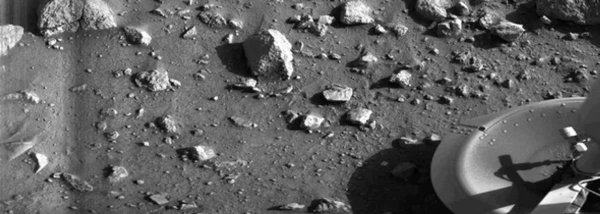
The authors of the new study claim that NASA's lander made a historic discovery 50 years ago that was dismissed. And the scientists have arguments for this.
According to scientists, in 1976, NASA's Viking 1 spacecraft possibly did find evidence of life on Mars. The study is published in the journal Astrobiology, reports Focus citing Space.
Viking 1 entered history as the first spacecraft to land on the surface of Mars. This happened in 1976. The instruments designed to detect life indicated that it could exist on Mars. However, on the other hand, the organic molecules necessary for life were not found. Therefore, scientists concluded that there is no life on Mars.
But the authors of the new study say that in fact, Viking 1 detected organic molecules on Mars, which means that the results of this mission were misinterpreted.
The instrument for detecting organic molecules on the Viking 1 spacecraft heated samples of Martian soil first to 120 degrees Celsius to remove excess carbon dioxide from the Martian atmosphere, and then to 630 degrees Celsius to vaporize any organic substances present in the soil, and then analyze them using a mass spectrometer.
Surprisingly, the mass spectrometer detected emissions of oxygen, carbon dioxide, and a small amount of methyl chloride and methylene chloride, whereas organic molecules, even those from meteorites, should have been present instead.
For the complete absence of organic substances, as claimed by the Viking 1 team, an unknown oxidizer was required. Meanwhile, it was assumed that carbon dioxide remained after observation in the sample container, and methyl chloride was considered terrestrial contamination from cleaning solvents that came from the clean room on Earth where the instrument was assembled.
The problem with this interpretation, according to the authors of the study, is that methyl chloride is not a cleaning solvent; it is a gas that boils at minus 24 degrees Celsius.
Nevertheless, the Viking 1 team claimed that the oxidizer not only destroyed organic compounds but could also explain the results of other supposedly positive tests for detecting life. At that time, scientists concluded that this mysterious oxidizer was some kind of peroxide, although peroxides have never been found on Mars.
But if there is microbial life on Mars, where are the organic molecules? Although organic molecules have been found on Mars by the Curiosity and Perseverance rovers, most of them are believed to have a non-biological origin, for example, from meteorites.
And although the Viking 1 spacecraft had a less sensitive mass spectrometer than modern rovers, this still does not explain why it did not detect organic substances at all. The authors of the new study believe that the answer was obtained in 2008 when NASA's Phoenix lander discovered perchlorate on the surface of Mars. Perchlorate is also an oxidizer, strong enough to break down organic substances from meteorites over thousands of years, but not strong enough to be the oxidizer that the Viking 1 team was looking for to explain the study results.
It is now known that organic compounds plus perchlorate form methyl chloride and carbon dioxide. The result of the reaction produces 99% carbon dioxide and 1% methyl chloride, which explains the carbon dioxide emission and cleaning solvent observed when heating the Martian sample to 630 degrees Celsius. Therefore, scientists concluded that the Viking 1 instrument actually detected organic molecules on Mars that are necessary for life through their decomposition products.
Scientists say this means that possibly, NASA's spacecraft did discover life on the Red Planet 50 years ago. The presumed life on Mars could be in the form of autotrophic bacteria. They use photosynthesis during the day to produce their own food and enter dormancy at night, storing the oxygen produced for use after waking up. This explains the oxygen emission detected by the Viking 1 spacecraft.
Scientists say that the misinterpretation of the Viking 1 study results led to the official position that no evidence of life on Mars was found in 1976.














Leave a comment