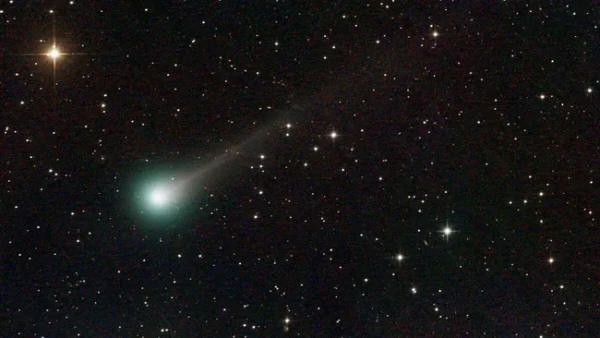
The icy "guest" will approach the Sun at a distance of about 76 million km.
After the excitement in 2025 surrounding three visible comets — especially 3I/ATLAS, astronomers say that another one may put on a show in spring 2026. What is known about it?
After the interstellar object 3I/ATLAS kept space enthusiasts and sky watchers on edge throughout 2025, astronomers have turned their attention to what they believe could be the "great comet" of 2026. This is C/2025 R3. The celestial body is currently racing towards the Sun and will approach Earth in April at a distance of about 70 million km — four times closer than 3I/ATLAS.
The comet, which humanity will only be able to see once, holds many mysteries. Such objects are rare and present particular challenges for observation. Scientists still cannot determine its exact trajectory. Its brightness remains unknown as well.
Will the new comet overshadow the super-popular 3I/ATLAS?
C/2025 R3 appears during a period of unusually high comet discovery activity. Six objects left a significant mark in 2024 and 2025.
First, there was the "devil's comet" 12P/Pons-Brooks, which was also called the "Mother of Dragons."
Then came C/2023 A3 (Tsuchinshan-ATLAS) and the bright C/2024 G3 (ATLAS). The latter was even dubbed the "New Year comet" — for its bright display for residents of the Southern Hemisphere at the turn of 2024 and 2025.
Astronomers were also attracted to C/2025 A6 (Lemmon) and C/2025 R2 (SWAN). The interstellar comet 3I/ATLAS caused a real sensation last year. Although it is already approaching the boundaries of our Solar System, it continues to be discussed.
Rising "star" C/2025 R3 (PanSTARRS)
The object was discovered on September 8, 2025, by the Pan-STARRS system (a pair of 1.8-meter reflecting telescopes on the summit of Haleakalā volcano in Hawaii). C/2025 R3 is a long-period comet with an orbital period that is currently unknown.
It is expected that April 2026 may be the only chance to see it. If further calculations show that the comet is indeed gravitationally bound to the Sun, its orbital period is likely so long that C/2025 R3 will not return during our lifetime.
According to scientists' calculations, the comet will reach perihelion on April 20, 2026. On that day, the icy "guest" will approach the Sun at a distance of about 76 million km. Just a week later, on April 27, C/2025 R3 will come closest to Earth (70.8 million km). At that moment, it will likely be at its brightest.
And here lies the main intrigue. The brightness of comets is notoriously unpredictable. Although C/2025 R3 has every chance of becoming the star of the year, it is unknown in advance how bright it will become.
Some predict that it will reach magnitude 8 — about as bright as Neptune. In other words, too dim for the naked eye, but easily visible in binoculars or a small telescope. Others believe that C/2025 R3 could reach a brightness of up to magnitude 2.5. In this case, it would be easily seen in the dark sky without additional optics.
For comparison: the visible magnitude of the North Star is 1.97.
The chances of R3 becoming a bright and easily observable night object may increase due to a phenomenon called direct scattering. As the comet passes between Earth and the Sun, its tail will reflect and scatter a large amount of sunlight towards our planet at the end of April 2026. For now, as new data comes in, scientists are adjusting brightness estimates, noting that the coming months will be crucial.
C/2025 R3 (PanSTARRS) will be best visible in the pre-dawn sky at the end of April for observers in the Northern Hemisphere, which includes Europe, and after sunset — in early May for residents of the Southern Hemisphere. However, be cautious, as at the moment of closest approach to Earth on April 27, the comet will likely "get lost" in the solar glare.
In addition to its potential spectacle, C/2025 R3 also holds scientific value.
Long-period comets are among the most "pristine" objects available for observation, as they preserve material from the time of their formation.
Spectroscopic studies planned by several observatories aim to analyze the gas-dust composition of the comet — searching for signs of water, organic molecules, and isotopic ratios that will help refine models of planet formation.
Such objects are also quite challenging to observe — at least because, due to their long orbital periods, they only appear before astronomers' eyes once. Moreover, their appearance is often unpredictable, which also complicates long-term study.
Whether C/2025 R3 will become the main astronomical hero of the year will depend on a fortunate coincidence of physical processes and precise timing, which cannot be fully predicted in advance. However, history shows that truly "great comets" — those that dominate the sky and capture the public imagination — remain a rarity, appearing only a few times per generation.