
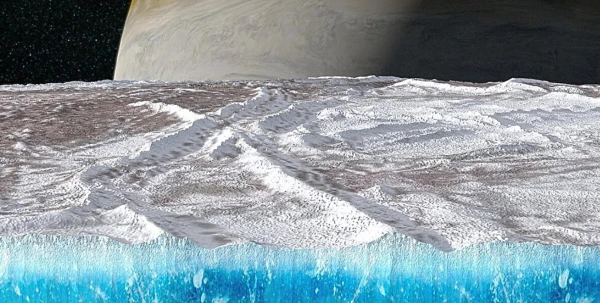
NASA's Juno spacecraft has determined the thickness of the icy shell of Jupiter's moon Europa. This is significant for understanding whether this world could indeed be habitable, reports Focus.
New data obtained by the microwave radiometer of NASA's Juno spacecraft, which orbits Jupiter, helped scientists determine the thickness of the icy shell of the moon of this planet called Europa. Scientists also received new information about the subsurface structure of Europa's icy shell. This is important for understanding the internal structure of Europa and assessing the possibility that extraterrestrial life may exist in its subsurface ocean. The study was published in the journal Nature Astronomy, reports Phys.
Jupiter's moon Europa has a diameter of about 3,100 kilometers, making it slightly smaller than the Moon. It is believed that beneath Europa's icy shell lies a vast ocean of water where extraterrestrial life may exist. There is evidence suggesting that the ingredients necessary for the creation and development of life may exist in this ocean.
Studying various characteristics of Europa's icy shell, including its thickness, is crucial for understanding the internal structure of Jupiter's moon and the potential existence of life-sustaining conditions there.
Although the MWR instrument on the Juno spacecraft was designed to study Jupiter's atmosphere, it has proven valuable for studying the icy and volcanic moons of the gas giant.
When Juno approached Europa's icy surface at a distance of about 360 kilometers, the MWR microwave radiometer collected data on the icy shell and its subsurface structure.
As a result, scientists found that the thickness of Europa's icy shell is about 29 kilometers, which aligns with astronomers' assumptions. However, scientists point out that this may only be the upper layer, primarily composed of frozen water. If there is an internal layer, the thickness of Europa's icy shell could be several kilometers greater.
Such a thick icy shell may complicate the transfer of oxygen and nutrients from Europa's surface to the subsurface ocean. Therefore, it is necessary to better study this process, which could affect Europa's potential habitability.
Astronomers also discovered small cracks and voids in the icy shell that extend several dozen meters deep from the surface. The small size and shallow depth of these structures suggest that they are unlikely to be significant pathways for the transfer of oxygen and nutrients from Europa's surface to the subsurface ocean.
Thus, the question of Europa's potential habitability remains open.
In 2030, NASA's Europa Clipper spacecraft will begin studying Jupiter's moon Europa, which will help determine whether extraterrestrial life could exist there.














Leave a comment