Jupiter's moon prompted scientists from the U.S. and Canada to make discoveries.
Scientists are confident that the water-ice-covered Jovian moon Europa hides a global ocean beneath its surface, but they doubt its habitability. In a recent study, they attempted to assess the level of activity in the moon's interior and came to an unpromising conclusion: tectonics there are unlikely to provide water enrichment.
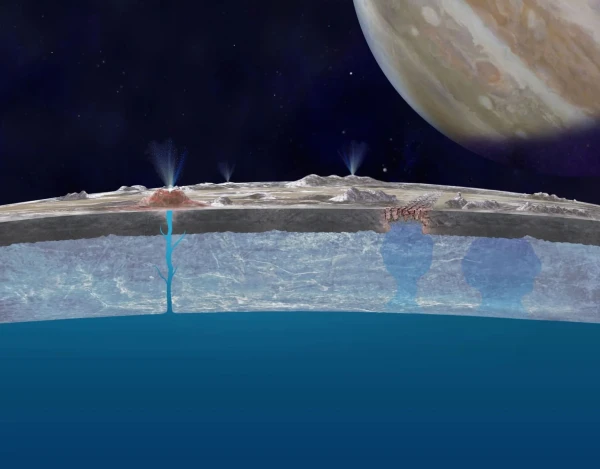
A few years ago, the Hubble Space Telescope detected water vapor plumes near the south pole of Jupiter's moon Europa. Estimates suggest they reached heights of hundreds of kilometers. This is considered one of the most important confirmations that there is indeed a layer of non-freezing water beneath the moon's icy crust.
The release of vapor to the surface, according to scientists, is a result of the same forces that sustain the hypothesized subglacial ocean: the gravitational pull of Jupiter. As Europa moves in its orbit around the gas giant, it is constantly being subtly compressed and stretched. This causes friction inside, thereby heating the moon from within.
According to the main theory, at times the ice of Europa cracks, and in the southern polar region, the cracks descend to maximum depths and reach the ocean. Due to the constant gravitational compression and stretching, these cracks periodically "suck" water and deliver it to the surface.
An even more interesting possibility cannot be ruled out: tidal friction in Europa's interior leads to the formation of hydrothermal vents on the ocean floor, similar to "black smokers." There is a suspicion that the first life on Earth arose near these mineral-rich hot water flows. To this day, chemosynthetic organisms thrive in complete darkness on the ocean floors thanks to hydrothermal systems.
This recently prompted a team of planetary scientists from the U.S. and Canada to investigate how likely tectonic activity is on the floor of Europa's subglacial ocean today. They reasoned that without active faults, water in the moon's interior would not receive the necessary substances from its silicate mantle to support hypothetical extraterrestrial life.
In an article for Nature Communications, the scientists examined four possible mechanisms for creating stress on the rocky ocean floor of the moon: deformation due to Jupiter's tidal forces, global compression of Europa as it gradually cools, movement of hot magma in the silicate mantle, and the formation of hydrated minerals: when rocks "absorb" water, meaning they "incorporate" its molecules into their crystalline structure, they increase in volume.
The calculations led the researchers to an unpromising conclusion: none of these "methods" can lead to the formation of sufficiently significant faults on the ocean floor of Europa. As planetary scientists write, Jupiter's gravity would need to create an internal stress of at least 2.1 million pascals within the moon, while in reality, it provides at best 54,000. The same applies to its compression from cooling. Europa's rocky "core" could only crack if it decreased in diameter by a whole kilometer, which seems implausible.