

On March 16, we will be able to admire the mysterious celestial body for the last time.
Comet 3I/ATLAS is once again stirring the minds of scientists: astrophysicists have discovered signs that it may be an alien spacecraft. We are trying to figure out whether we should expect the arrival of extraterrestrials soon.
Comet 3I/ATLAS has already made quite a noise: unlike most known comets, it does not orbit the Sun. Its homeland lies somewhere beyond the Solar System. Additionally, it accelerated during observations.
Such occurrences are rare: 3I/ATLAS is only the third observed interstellar object after the asteroid Oumuamua and the comet Borisov. Moreover, it has unique properties. Naturally, people immediately began to wonder: could this be an alien spacecraft? So far, there has been no substantial evidence of the object's artificial origin.
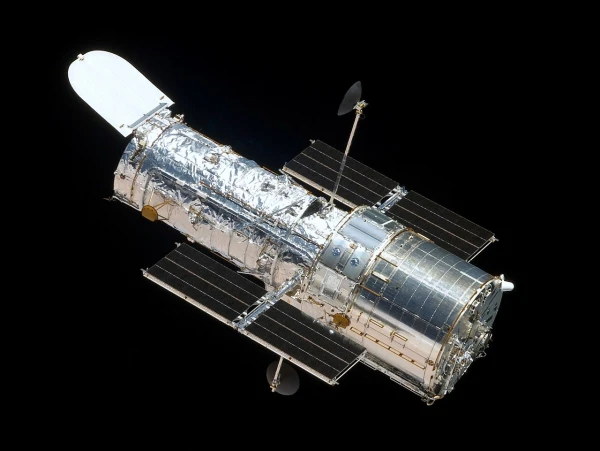
But recently, astrophysicist Abraham "Avi" Loeb, director of the Institute for Theory and Computation at the Harvard-Smithsonian Center for Astrophysics, published material with very interesting observations based on images from the Hubble telescope. By the end of winter, the Sun, Earth, and the comet aligned almost in a straight line — light fell directly on the object's "back." This allowed observers to see, in addition to the anti-tail directed toward the Sun (a normal phenomenon for comets), three small streams. They are small only by cosmic standards — each extends for 25,000 km.
The most interesting part is that these mini-streams are arranged remarkably symmetrically. There are exactly 120 degrees between them. If you take, for example, a tripod for a camera, the angle between its legs will also be exactly 120 degrees when projected onto the ground.
And this entire structure rotates: 3I/ATLAS completes a full rotation approximately every 7 hours. Another curious feature is that the axis of rotation is directed almost straight at the Sun (with a deviation of 10–20 degrees).
The scientist's colleague, Frank Laukien, notes that these streams closely resemble the exhaust of jet engines used for orienting an object in space.
— The symmetrical angular distance of 120 degrees between the three mini-jet engines is astonishing! It is hard to imagine such symmetry in a natural macroscopic object. The key question is: are the three symmetrical mini-jet engines the minimally viable configuration of propulsion systems for reorienting an object in three-dimensional space?
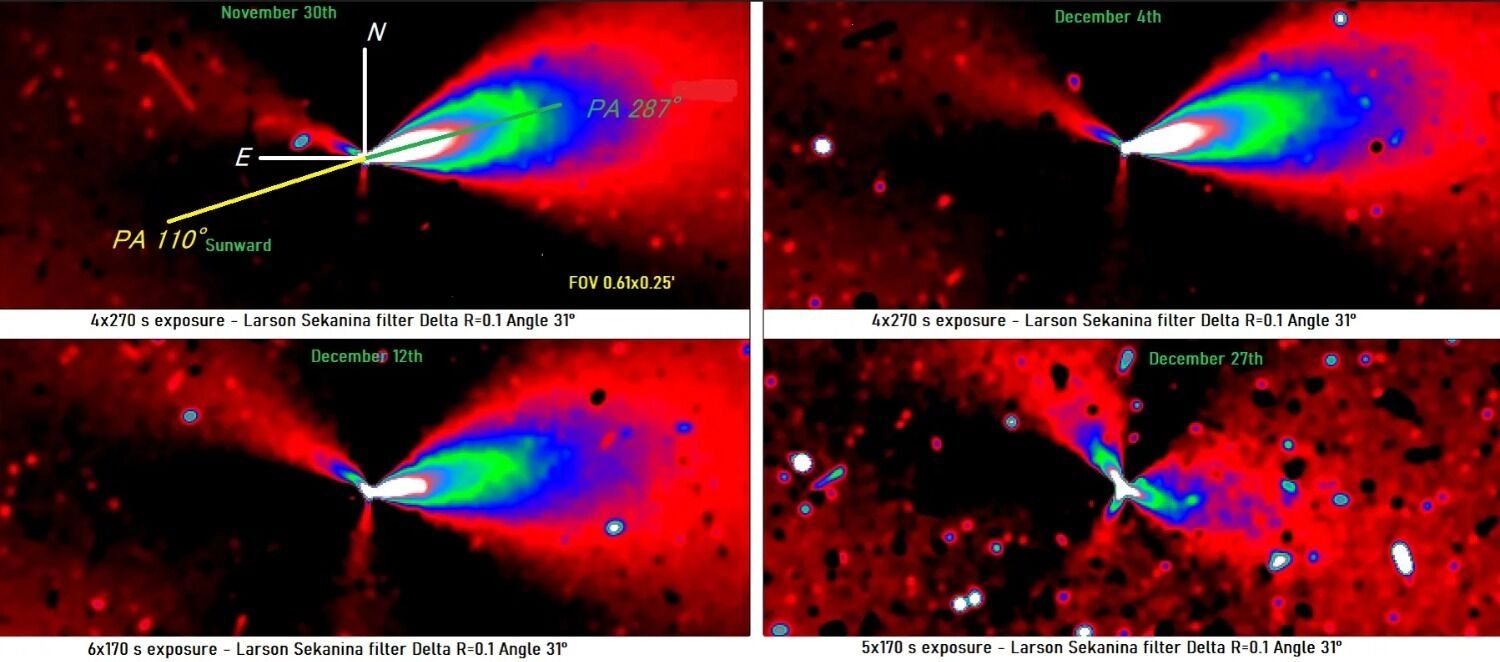
For now, these are just questions and assumptions. It cannot be claimed that 3I/ATLAS is an alien spacecraft yet. It is possible that the arrangement of gas and dust streams is random — everything just coincided so precisely at the moment of observation. Over time, Avi Loeb has counted 18 anomalies. By most indicators, this interstellar object is still a comet.
However, the hope for a meeting with representatives of an alien race can be set aside for now. At the moment of closest approach to Earth on December 19, 2025, 3I/ATLAS will be on the opposite side from the Sun. And now this object is rapidly leaving the boundaries of the Solar System. On March 16, 2026, the comet will fly past Jupiter and, at a speed of 221,000 km/h, will head into interstellar space. We will never see it again.














Leave a comment