
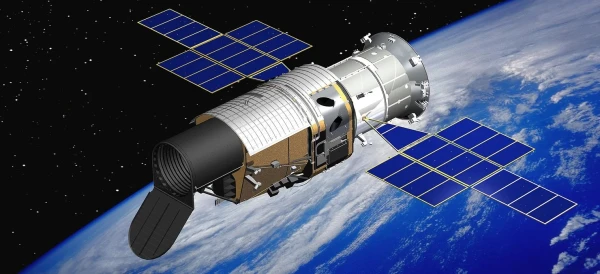
Chinese scientists conducted a preliminary study of the capabilities of the new 'Xuntian' space telescope. It will be launched in 2027 and has an important feature.
China is actively preparing for the launch of the 'Xuntian' space telescope, scheduled for early 2027, which will be in the same orbit as the 'Tiangong' space station. Scientists have just completed full-scale modeling of the telescope's observations of space as part of the launch preparations. The study was published in the journal Research in Astronomy and Astrophysics, reports Space.
The Chinese 'Xuntian' space telescope is being actively prepared for launch early next year. It is equipped with a primary mirror 2 meters wide, slightly smaller than that of NASA's Hubble telescope. However, the authors of the study claim that it will be a much more effective tool for surveying space. The Chinese telescope is equipped with a camera with a resolution of 2.5 billion pixels and has a field of view approximately 300 times larger than that of the Hubble telescope. It will be able to observe space across a wide range of the light spectrum: from near-ultraviolet to near-infrared, and create images with very high resolution.
As preparations for the telescope's launch enter the final stage, Chinese scientists conducted modeling of space observations to determine the observatory's capabilities. The results of the modeling show that the 'Xuntian' telescope could make a significant contribution to the study of the universe and improve understanding of its nature.
The Chinese space telescope will study other galaxies, the evolution of the Milky Way, as well as stars and planets. It may also provide insights into dark matter and dark energy. The former is a mysterious invisible substance that played a crucial role in the formation of the universe's structure, but cannot be seen directly, as dark matter neither emits nor absorbs light. However, it interacts with ordinary matter through its gravity. As for dark energy, it is a mysterious force that drives the accelerated expansion of the universe.
Chinese scientists state that the 'Xuntian' telescope will be as powerful as NASA's Webb and Hubble space observatories, but it has one important advantage.
After launch, the 'Xuntian' telescope will be in low Earth orbit in autonomous mode, but will orbit the Earth on the same path as the Chinese 'Tiangong' space station. As shown in the video, the telescope will be able to dock with 'Tiangong', and astronauts will be able to perform maintenance, repairs, and even upgrades to the observatory. This is impossible for both the Hubble telescope, which is near Earth, and the Webb telescope, which is far out in space. The last time NASA astronauts performed repairs and upgrades on the Hubble telescope was in 2009.















Leave a comment